The wood itself
What curly birch actually is
A variety of silver birch whose grain refuses to run straight. Here is where it grows, why it figures, how little of it there is, and how it behaves once it reaches your bench.
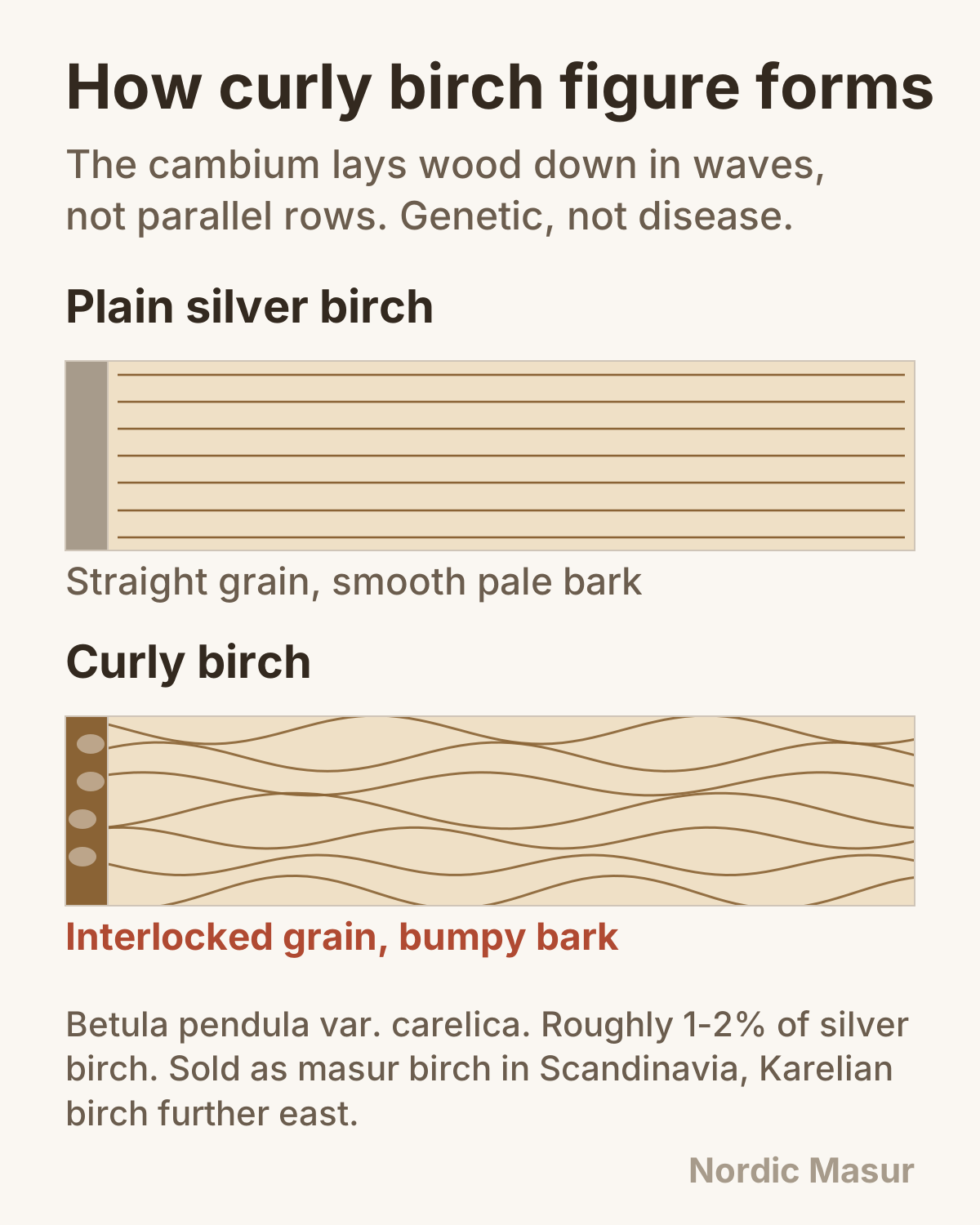
Curly birch is silver birch with a figure in the grain. Botanically it is Betula pendula var. carelica, a variety rather than a species: leaf, catkin and bark are the same as any birch in the stand, and a figured tree will cross with a plain one growing beside it. The difference is inside the trunk.
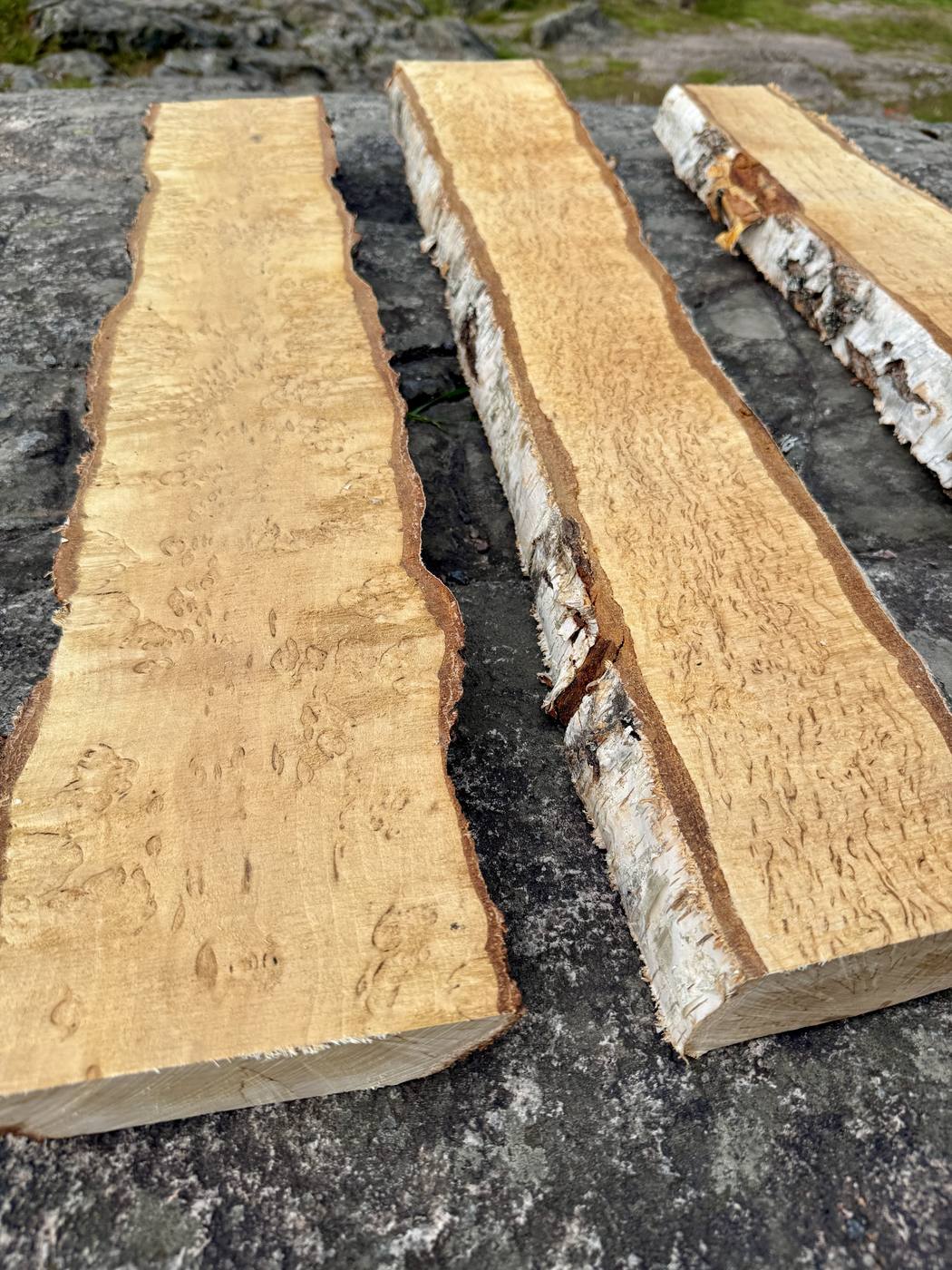
In an ordinary birch the fibres run more or less parallel to the stem. In a figured tree they do not. They swirl, fold back into the wood and wrap around pockets of dark tissue, so a sawn face shows flecks, short streaks and closed rings against a pale ground. Turn the piece under a lamp and the pattern seems to move, because fibre ends cut at different angles catch the light differently.
- Botanical name
- Betula pendula var. carelica
- Occurrence
- 1–2% of silver birch
- Specific gravity
- 0.65–0.68
- Janka hardness
- ~1,250 lbf
- Where it grows
- Finland, Karelia, the Baltics, Belarus
Three names, one wood
English-speaking makers usually say curly birch. European dealers say masur birch, from the German Maser, meaning figure in wood. Karelian birch is the third name, after the region either side of the Finnish border where the best stands have always been, and it is the name in the botanical variety and in most of the older literature. Finnish has its own word, visakoivu, from visa: hard, tight, difficult to work.
All three describe the same timber and we use whichever one you use. One caution. A few sellers apply curly birch to birch with a wavy, fiddleback figure, closer to curly maple. That is a different pattern. What we cut is the dense, irregular, flecked wood described above.
Why the figure happens
It is genetic. The tendency is inherited, it travels in seed and in grafts, and a figured tree moved to different soil stays figured. For most of the last century the pattern was blamed on a virus, a fungus, boring insects or frost damage. None of it held up. Controlled crosses between figured parents produce a high share of figured offspring, which no pathogen explanation survives.
What happens at the cell level is narrower to describe. The cambium in a figured tree lays wood down irregularly: bands of soft parenchyma instead of ordered fibre, bark pockets buried as the trunk thickens, dormant buds overgrown rather than shed. The dark markings in a finished piece are those inclusions seen in section. Why the cambium behaves that way in one seedling and not in its sibling is still not settled, and anyone who tells you otherwise is guessing.
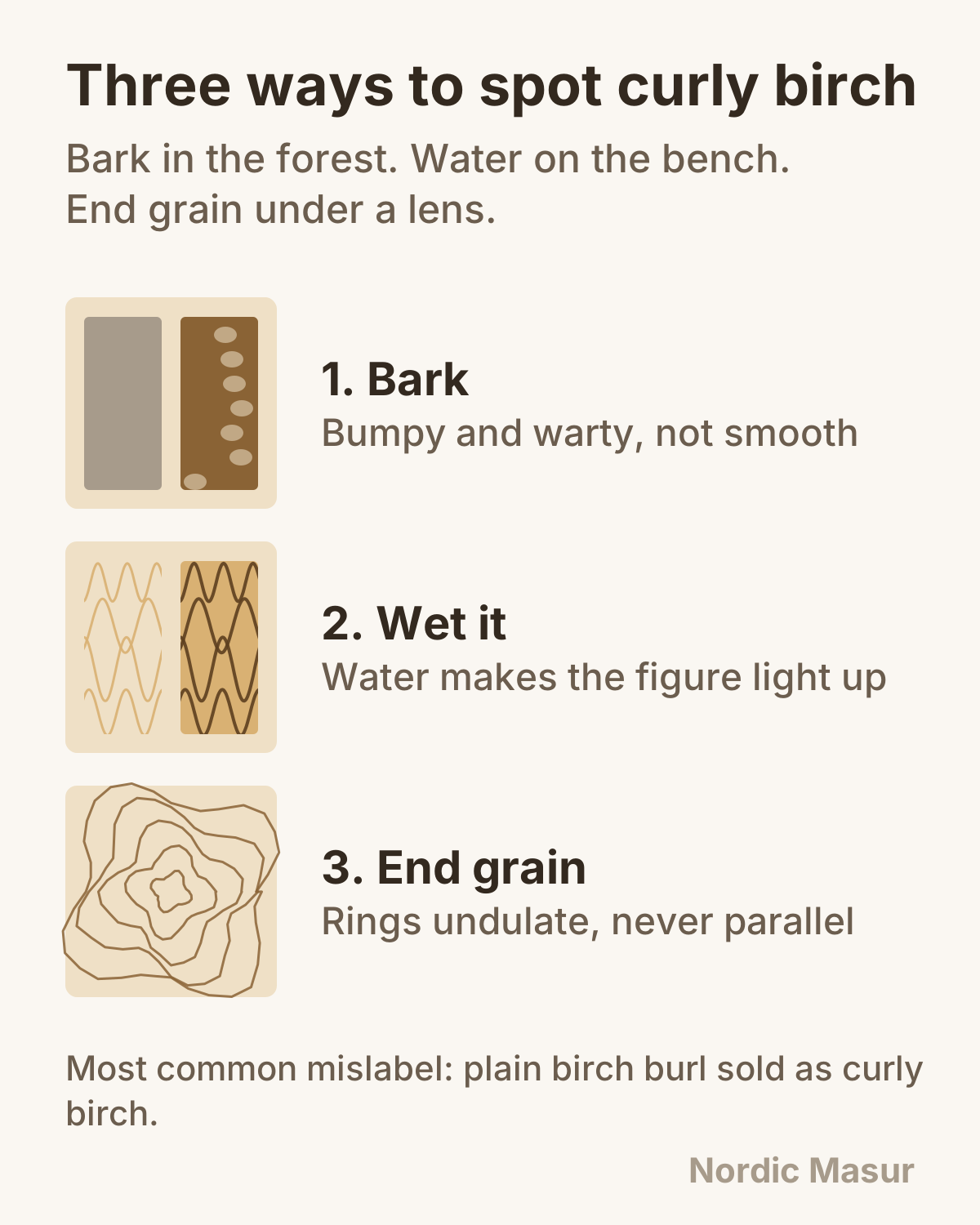
A figured tree can sometimes be read from outside: lumpy or dimpled bark, shallow grooves up the stem, a trunk that never quite straightens. Sometimes. The reliable answer comes at the saw, which is why we open logs before we commit to them.
Rarity is not a marketing line here
One or two birch in a hundred carry the figure, and planting does not move that number much. A figured tree is usually small, 13 to 25 cm at the butt, and rarely gives a long clean stem. Then the losses start. Figure fades towards the top and towards the pith, the inclusions that make the pattern also start the checks, and a stem that looked promising can yield two good scale pairs and a barrow of firewood. That is why this wood is sold and photographed piece by piece rather than by the cubic metre.
Under a tool
Denser and harder than plain birch: specific gravity 0.65–0.68 against about 0.60, Janka around 1,250 lbf, sitting between plain birch at roughly 1,100 and sugar maple at 1,450. It feels like a hard birch, not like an exotic.
The interlocked grain is the thing to plan for. A plane set for straight stock will tear out. Go to a high cutting angle and light passes, or skip the plane and scrape and sand. On the lathe it cuts cleanly with a genuinely sharp gouge, and shear-scraping leaves a better surface than abrasive alone. It sands to a burnish, drills and taps well, and glues without complaint.
Oil finishes suit it. The dark tissue drinks more than the pale, so the pattern deepens as you finish instead of flattening. Many knife makers stabilise it with resin. Not structurally necessary at 13–15% moisture, but it evens out the softer dark areas and is worth doing on a kitchen handle that will get wet.
Where it is the wrong choice: anything long, thin and structural. Interlocked grain buys you nothing in a lamination or a straight spar, and plain birch, ash or a straight-grained maple will serve you better. We will say so if you ask.
What it is used for
Knife handles are the largest and the oldest use; the Nordic puukko has been handled in this wood for as long as there have been puukot. After that, turned bowls, boxes and pens; guitar backs and sides and kantele bodies; furniture and interior panelling as a feature rather than a whole piece; jewellery boxes, pipes, cue splices and small carved work.
Different uses want different material, which is the whole point of our three grades. Sizes and forms are on the products page.
Looking for something specific
Tell us what you are making. Sizes, quantity and how much figure you want can go in now or later.
Prefer email? Write to hello@nordicmasur.com.