Wood Turning Blanks: Species, Size and Moisture
A turning blank is decided on three things and in this order: whether the grain orientation suits the piece, whether the size leaves enough after the waste is gone, and whether the moisture content matches how you intend to work. Species comes fourth, and most people get that order backwards.
One thing changes how the rest of this reads. We do not sell blanks. Nordic Masur saws curly birch into logs, slabs and boards, and the turner cuts their own blanks out of them. That is a sawmill's position rather than a blank shop's, and for anyone who knows what they are making it is the more useful one: you choose the orientation, the dimension and the waste allowance instead of buying someone else's guess at all three.
Grain orientation is the first decision
A piece cut with the grain running along its length is a spindle blank, and it is what you want for anything held between centres: handles, boxes, pens, goblets, chair parts. A piece cut so the grain runs across it is a bowl or faceplate blank, turned with the grain perpendicular to the axis.
That distinction is not a labelling convention. It decides where the end grain sits on the finished piece, which decides how it cuts, how it sands, and how it moves as it dries. A bowl turned from spindle-oriented stock has end grain in its base rather than on two opposing sides, and it cracks differently. Neither is wrong, and the choice is made with the saw rather than on the lathe.
When blanks are quoted by three dimensions, the last figure runs along the grain: 150 × 150 × 50 mm is a disc-shaped bowl blank 50 mm deep, 50 × 50 × 300 mm is a spindle blank. Cutting your own, mark the grain direction on the face in pencil before the offcuts get mixed up.
Getting bowl blanks out of a log
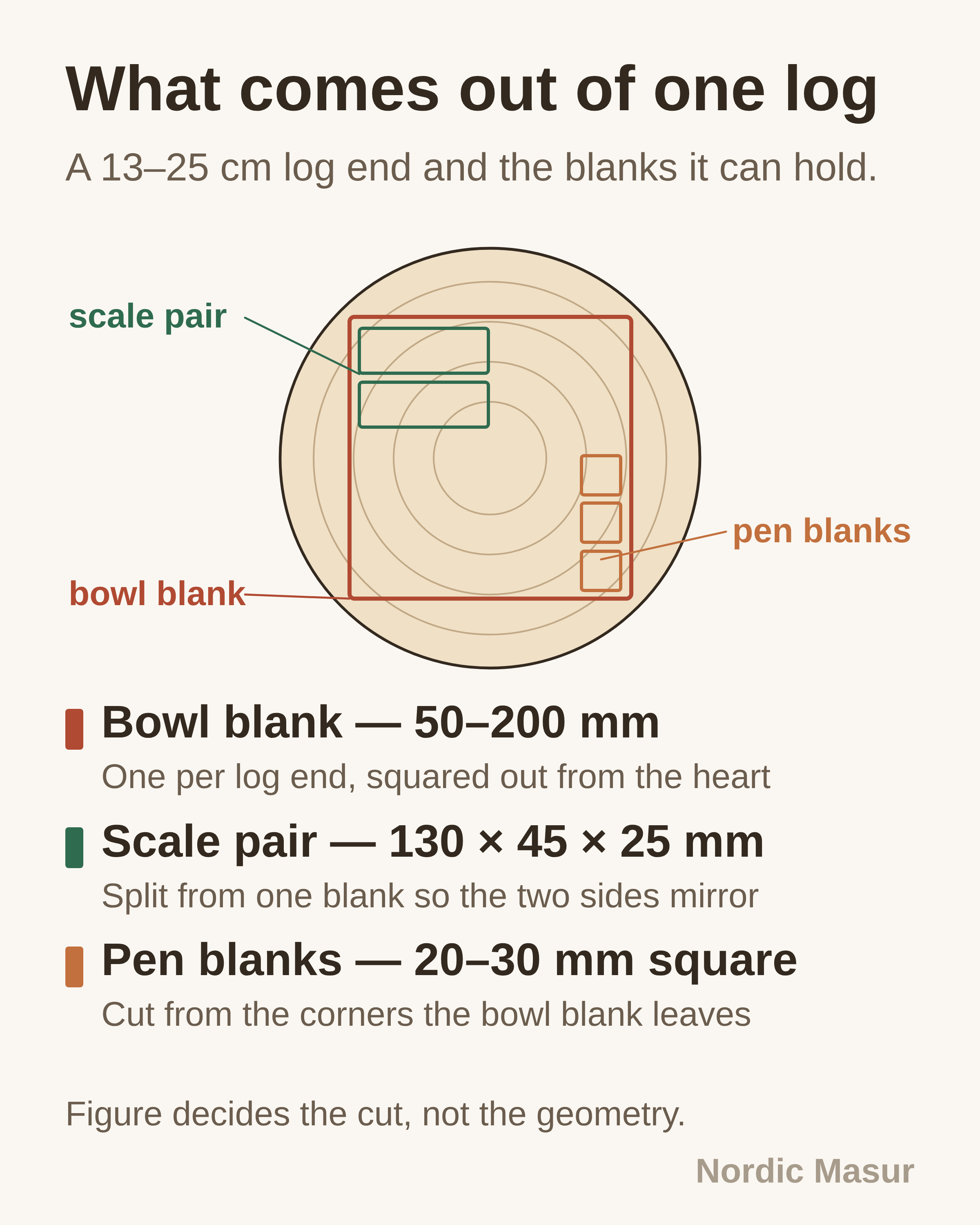
A log is the starting material for anything faceplate-oriented. Ours run 13 to 25 cm in diameter and 0.5 to 1.5 m long, green or air-dried as you ask for them, which sets the ceiling on what can come out: a blank cannot be wider than the log, minus the pith and minus the sapwood if you are excluding it.
Crosscut the log into lengths a little longer than the blank depth you want, then rip each length either side of the pith. The pith has to come out; it is the one part of the section that checks reliably, and a blank with pith through it is a blank with a crack in it. Each half-round then gives a blank of roughly 100 to 200 mm across, with the upper end needing the upper end of the log diameters.
The yield diagram on this post shows what comes out of a log of that size once the pith, the sapwood and the end checks are off, which is a more honest answer to "how big can I get" than any maximum figure. Then allow for loss again on the lathe: a finished bowl ends up 20 to 30 mm smaller in diameter than the blank once bark, sapwood and mounting waste are gone, and depth loses proportionally more, so 50 mm of blank makes a shallow dish and anything that reads as a bowl wants 80 mm or better.
Large figured bowls are a separate problem. Figure occurs in trees that grow slowly and stay small, so for a 400 mm figured bowl curly birch is not where to look.
Getting spindle and small blanks out of a board
Slabs and boards are the stock for spindle work, pen barrels, handles and anything else that runs along the grain. Ours come 10 to 25 cm wide, 15 to 50 mm thick and 0.5 to 1.5 m long, cut to the thickness you ask for with whatever allowance you want left on.
The arithmetic is simple enough to do before ordering. A 25 mm board gives one row of 20 mm square blanks across its thickness; a 50 mm board gives two, with the saw kerf and a clean-up pass taken off. Across the width, a 20 cm board gives seven or eight such strips. Rip the strips full length, crosscut to blank length last, and you waste far less than cutting each piece individually.
Ask for the thickness you actually want. Cutting 30 mm blanks out of a 50 mm board means resawing and losing the difference; asking for the board at 32 or 35 mm costs nothing extra and saves the operation.
Moisture, and which state to ask for
Green wood is above 30 percent moisture, cuts like butter, is kind to edges and moves a great deal. It suits rough-turning to an even wall and setting aside, or once-turned pieces where the bowl going oval is the intended result. Logs come green or air-dried, the buyer's choice, and green is the usual one for carvers and for turners who rough out wet.
Air-dried stock has come down towards ambient over months outdoors. Our slabs and boards are mainly air-dried, finished with a kiln cycle in autumn, and dispatched at 13 to 15 percent moisture content. That is a shipping and storage state rather than a workshop equilibrium. A heated workshop in a northern winter settles wood to 7 or 8 percent, so stock needs to sit where it will be used before it is turned, particularly anything turned thin or glued. Instrument work usually asks for 6 to 8 percent, which means conditioning in your own shop rather than a different product.
Standing tree to a board we will ship takes one to three months depending on the drying method, with felling concentrated between November and March when the ground is frozen.
Species, and what actually differs
For bowls and cups the useful properties are fine even pores, dimensional stability, and enough density that a rim does not bruise. Birch, maple, cherry, pear and the fruitwoods all qualify. Curly birch sits at a specific gravity of 0.65 to 0.68 against about 0.60 for plain silver birch, with a Janka hardness around 1,250 lbf against about 1,100, which holds a crisp detail without being hard on gouges.
For long spindle work, straight grain matters more than hardness, and figured wood is a liability in thin sections because the fibre changes direction where the section is weakest. For pens and small work the opposite holds, because the scale of the figure relative to the object is at its most favourable.
Figure varies within a single log, which is why hand grading exists. What our three grades mean, and what share of the sawn output falls into each, is under grades. All three dry in the same cycle to the same moisture and are equally strong; only the figure differs.
What to specify when you order
Give the finished piece, not the blank. A sawyer told you are making 120 mm bowls with a 40 mm foot opens a log differently from one told "150 mm blanks". State the finished dimensions, the orientation you intend to cut for, the board thickness you want, the moisture state you are set up for, and whether pieces need to match. Matching overrides the rest, because matched pieces have to come out of one log and that is decided before the log is opened.
What we saw and the sizes it comes in are listed under products, and how the wood behaves under a gouge is on the curly birch page.
Working on something in curly birch?
One line is enough to start. If you already know the sizes and quantity, add them below and we can quote with photos of the actual boards.
Prefer email? Write to hello@nordicmasur.com.