What Blanks Actually Come Out of a Curly Birch Log
A curly birch log is 13 to 25 cm in diameter and 0.5 to 1.5 m long, and by the time the pith, the sapwood, the end checks and the unfigured zones are out of it, a good deal less than half of it is usable. That is the whole explanation for why figured wood comes in the sizes it does, and why the answers to "can you do it bigger" and "can you do it longer" are usually no.
One thing to be clear about first. We sell the log and the board, not the blank. Logs go out at 13 to 25 cm diameter and 0.5 to 1.5 m long, green or air-dried as you choose; slabs and boards at 10 to 25 cm wide, 15 to 50 mm thick and 0.5 to 1.5 m long, cut to the thickness you ask for. The blanks come out of those on your own saw, and what follows is the arithmetic of how many.
Where the log starts
Trees carrying the figure grow slowly and stay small. One or two silver birches in a hundred carry it at all, and those are recognisable in the stand by a knobbly, dimpled trunk under the bark. Slow growth is part of the mechanism, so a curly birch of 40 cm diameter does not exist in commercial quantity.
Felling runs November to March when the ground is frozen, with smaller volumes through the rest of the year. Logs are cut to 0.5 to 1.5 m because that is the length over which a stem of this size stays reasonably straight and free of the large knots that would halve the useful section anyway.
No one knows what is inside until it is opened. An experienced buyer reads the outside well enough to be right most of the time about whether a tree is figured, and not at all about how tightly. Grade is decided after the saw, by hand, on the sawn face.
What comes off before anything is cut
The pith and the first centimetre or two around it come out of anything that has to stay stable. Pith-centred pieces split radially as they dry, without exception.
The sapwood is the pale outer band. It is sound wood and not figured in the same way, so it comes off where the figure is the point and stays on where a contrast band is wanted.
The ends go. Every log end checks as it dries, and the checks run in several centimetres. A 1.5 m log gives well under 1.5 m of clear length, which is worth allowing for when you plan your cutting list.
Then the defects: knots, bark inclusions that are too loose to hold together, insect damage where there is any, and rot. Insect-damaged wood is not figured wood and it is discarded rather than sold as character.
What is left, and what it becomes
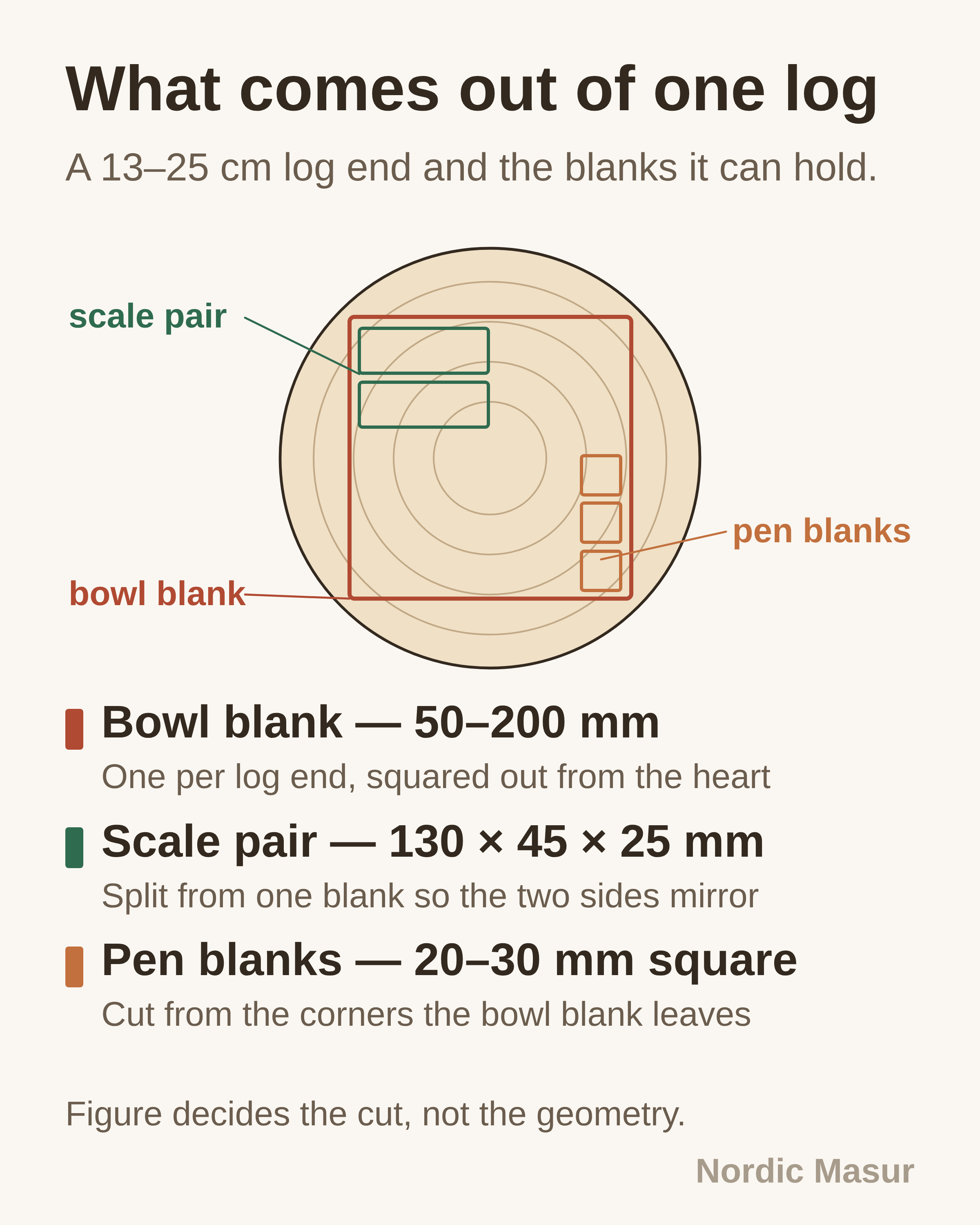
The yield diagram on this post lays this out in proportion, which is the clearest way to see it. In words, what a log of this size will give a maker who cuts it up:
- Bowl blanks of roughly 100 to 200 mm across, ripped either side of the pith and crosscut to depth. The upper end needs the upper end of the log diameter range, and the number of logs that will give a 200 mm blank clear of pith and sapwood is small.
- Cup and kuksa blocks, which is where most of a green log goes. A block about 100 mm across and 100 mm deep plus handle length takes a coffee-sized cup, and a metre of log carries several end to end.
- Knife scale pairs, conventionally around 130 × 45 × 25 mm and resawn from one block so the halves mirror each other. Being small, they come from around defects and from the parts of the log that will not give a bowl blank, which makes them the cheapest thing to get out of a log in yield terms.
- Pen blanks, small box blanks and inlay stock, out of the offcuts. They are the most efficient use of the tree and the reason very little sound figured wood is wasted.
The sequence matters, on your bench as much as in our yard. Whoever opens the log decides what it can become, and the decision is a one-way door: rip it into 25 mm boards and the 150 mm bowl blank is gone. If you want the large pieces, buy the log and cut the boards last. If you want boards, say what thickness, because we cut to what you ask with the allowance you want, and that saves you the resaw.
Why the big pieces do not exist
Boards wider than about 60 cm effectively do not exist in this species, and long stock with unbroken figure does not exist in practice. Both statements are about the tree rather than about supply.
Width is limited by diameter, and diameter by the slow growth that produces the figure. Length is limited differently: the figure is not continuous along a stem. It comes and goes, tightening and fading over the length of the trunk, so a metre of consistent figure end to end is a rarity rather than something to plan around. Anyone offering long figured boards in quantity is either working in a different species or joining pieces.
If your design needs a large continuous figured surface, the honest answer is that it needs joints and the figure will be interrupted at each one. Better known at the drawing stage than at the order stage.
Grades are a description of the sawn face, not of the tree
All three grades dry in the same cycle to the same moisture and are equally strong. Premium is roughly 10 to 15 percent of what is cut, Standard 40 to 50 percent, Economy the rest, and the difference is how dense and even the figure is.
The proportions are the point. Premium at 10 to 15 percent is not a marketing tier; it is how much of the sawn output of an already rare tree has figure tight and even enough to carry a large visible surface. Wanting ten matched Premium bowl blanks means finding a log that will give ten of them, which is a different problem from finding ten Premium pieces. What each grade covers is set out under grades.
For a great deal of work the lower grades are the correct buy rather than the economical one. A handle partly under a wrap does not need tight figure across its whole surface, and a pen barrel needs dense figure in a 20 mm square and nothing else. Buying Premium for either is paying for evenness you will cut away.
What this means for your order
Give the finished piece dimensions rather than the blank dimensions and let the waste be added. A 150 mm bowl wants a blank of 170 to 180 mm, and whether a log will give that depends on what is in the yard this month rather than on a catalogue.
Say early if pieces have to match, because matched material comes from one log and that is the constraint deciding which logs are worth opening. Say whether you want a log or boards, at what thickness, and green or air-dried, since both are available on logs and the choice is yours. And say whether the figure has to run across the whole surface or only part of it, because that decides the grade you actually need.
What we cut and the sizes it comes in are listed under products, and an enquiry with those answers in it gets a specific reply rather than a request for more information. Send it through contact.
Working on something in curly birch?
One line is enough to start. If you already know the sizes and quantity, add them below and we can quote with photos of the actual boards.
Prefer email? Write to hello@nordicmasur.com.