Tung Oil vs Danish Oil on Figured Wood
Tung oil is a single ingredient: a drying oil pressed from the nuts of Vernicia fordii, which cures by oxidising and polymerising in the wood rather than by evaporating. Danish oil is not an ingredient at all but a category of blend, typically a drying oil plus an oil-modified varnish resin plus a solvent to thin it, and the recipe is different in every tin. That asymmetry is the whole comparison, and most of the arguments about which is better are two people describing two different products that happen to share a name.
What is actually in each tin
Pure tung oil contains tung oil. Good suppliers sell it with nothing else in it: no driers, no solvent, no resin. It is thick, it smells strongly for the first fortnight, and it is slow.
Danish oil is a working recipe rather than a defined substance. A typical one is a third drying oil, a third varnish resin, a third white spirit, with metallic driers added to speed the cure. The oil is usually boiled linseed, sometimes tung, sometimes a mixture. The resin is usually an oil-modified alkyd, occasionally a phenolic. Because none of that is regulated by the name on the tin, two products both labelled Danish oil can behave differently enough that a schedule worked out for one will not transfer to the other. Read the safety data sheet before you plan a finishing schedule around a new brand; it will tell you the solvent and usually the oil type, which is most of what you need.
The same warning applies to anything sold as a tung oil finish. That phrase describes an appearance, not a contents list, and a good number of those products contain little or no tung oil. If you want tung oil, buy something whose label says pure tung oil and nothing else.
How each one behaves
Cure time separates them more than anything else. Pure tung oil needs two to three days between coats in a warm workshop and considerably longer in a cold one, and a full schedule of five to seven coats can run to a month. Danish oil recoats in four to eight hours because the solvent flashes off and the driers push the oxidation along, and a three-coat job is done in a weekend.
Build follows from that. Tung oil stays almost entirely in the wood and builds a surface film only after many coats, so the result is close to bare wood to the hand, with a low sheen that grows slowly. Danish oil carries varnish resin, so each coat leaves a thin film behind and the sheen arrives after two or three coats.
Colour is where the linseed content shows. Tung oil starts pale and ambers slightly, and it is noticeably more stable over years than linseed. A linseed-based Danish oil ambers more on application and keeps ambering, which on walnut or oak looks like depth and on a pale wood looks yellow.
Water resistance in practice goes to Danish oil, because of the resin, though a fully completed tung oil schedule closes the difference. Repairability goes to tung oil, because you can scuff and recoat a worn patch and it blends invisibly, which a resin-bearing finish does less reliably.
Why figured wood changes the answer
Figure is an optical effect. What you see as curl or flame is light entering fibres that are pointing in constantly changing directions and being reflected back at different angles, so the pattern shifts as you or the light moves. A finish increases that effect by filling the open surface cells with a medium whose refractive index is nearer the cell walls than air is, which lets light travel further into the wood before it is scattered back. The deeper that light path, the more depth the figure appears to have.
That gives a clear rule. A thin, low-viscosity finish that penetrates before it cures will lift figure more than a thicker one that sits on the surface, and a film finish applied straight onto bare figured wood tends to flatten the effect and make it look as though the pattern is under glass.
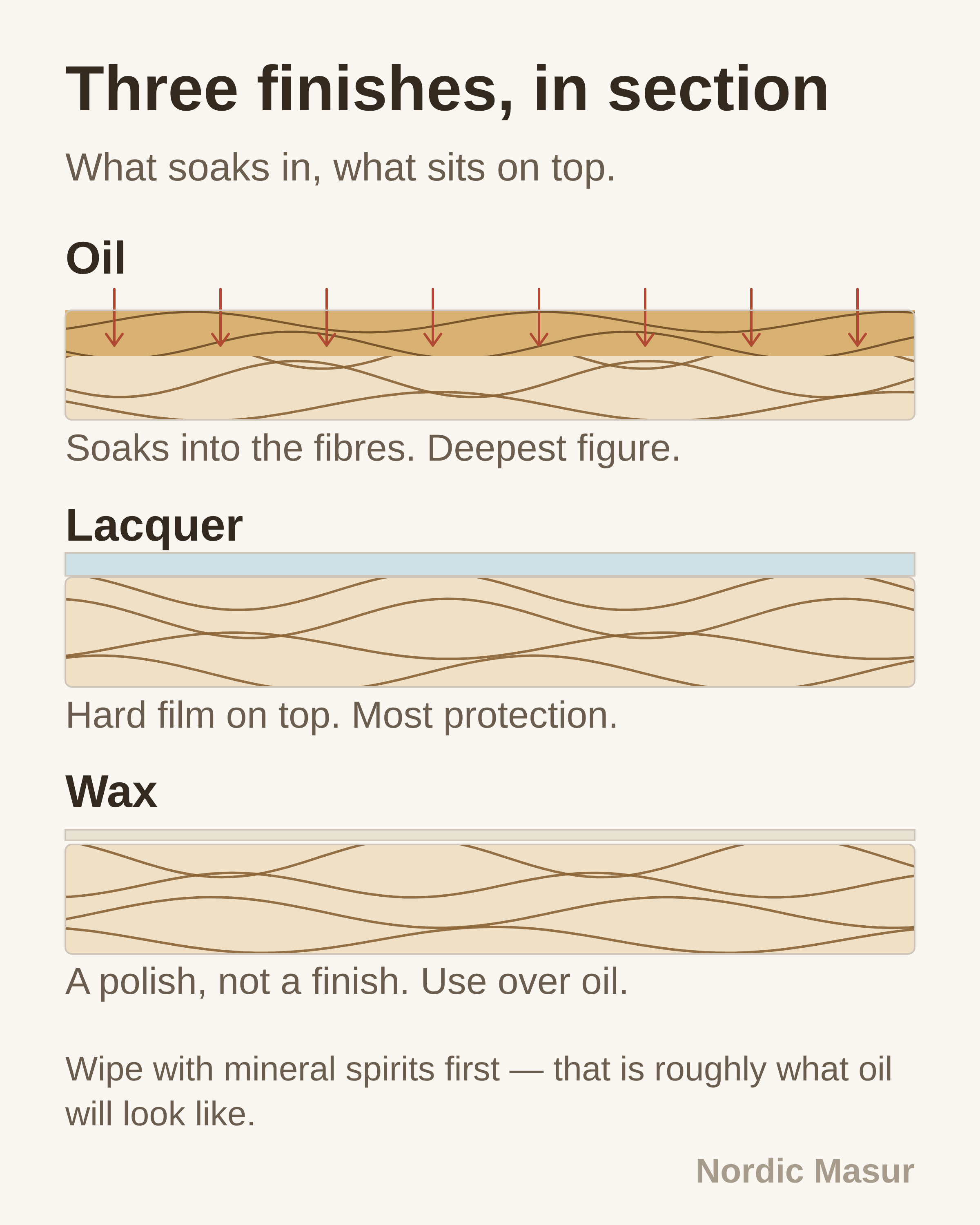
This is where pure tung oil has a problem and a solution. Straight from the tin it is too viscous to penetrate well, so the first coats should be cut with a solvent, commonly one part oil to one part white spirit or citrus solvent for the first coat, two to one for the second, and neat from the third onward. Danish oil arrives pre-thinned, which is why a first coat of it often penetrates better than a first coat of unthinned tung, and why so many makers who tried both concluded that Danish oil lifts figure more. It was a viscosity comparison, not an oil comparison. The penetration diagram with this post shows what reaches the interlocked fibre and what stops at the surface.
Curly birch as the worked example
Curly birch makes the differences easy to see, because it has two surfaces in one piece. The pale ground is ordinary birch, moderately dense at 0.65 to 0.68 specific gravity, and it takes oil evenly. The dark inclusions of bark and parenchyma running between the twisted fibres take oil much faster and darken much further, so contrast between ground and figure is under your control at the first coat and mostly fixed after it.
An over-thinned first coat floods the inclusions, they go nearly black, and the figure reads as a scatter of dark spots instead of a pattern with gradations in it. A first coat that is too heavy sits on the surface, dries glossy in patches and blotches, because the places where the fibre turns end-on behave like end grain and drink at a different rate from the rest. Sanding to 400 grit rather than stopping at 180, and wiping the first coat off thoroughly after five to ten minutes rather than letting it sit, controls both problems.
Our sawn stock ships at 13 to 15% moisture content, above where an oil finish wants the wood in a heated interior. Oil cured onto a piece that is still going to lose two or three percent ends up over a surface that shrinks beneath it. Let the material sit for a week or two first; how it is dried is under curly birch.
Choosing, by object
For a knife handle in figured wood, pure tung oil thinned for the first coats: it leaves no film to chip at the bolster, it repairs invisibly after a season of carry, and the slow schedule is not a problem on a small piece you were going to leave to cure anyway. For a turned bowl or a cup, see the separate question of food contact, which is about full cure rather than about which oil. For a furniture panel or anything that will be wiped down, Danish oil, because the resin buys real water resistance and three coats in a weekend is worth something. For a guitar body, neither on its own; oil is a sealer under a proper film finish, and the choice there is about what goes over the top.
Whatever you choose, test it on an offcut from the same board, not on a different piece of the same species. Figure density varies along a log, and an offcut from your own board is the only sample that tells you what your piece will do. Since you are cutting your own blanks out of a board, the offcuts are already on the bench; if you want extra for testing, say so when you ask for a quote. Dimensions as we cut them are under products.
Working on something in curly birch?
One line is enough to start. If you already know the sizes and quantity, add them below and we can quote with photos of the actual boards.
Prefer email? Write to hello@nordicmasur.com.