Tonewood Beyond Ash and Alder
Swamp ash stopped being a dependable material somewhere around 2018 to 2020, and it has not come back. Fender said in 2020 that it would largely stop specifying ash outside a few high-end and reissue lines, and the reason was supply rather than preference: emerald ash borer had worked through ash across a large part of the eastern United States and Canada, and the southern bottomlands where the light, wet-grown trees were cut had been flooding often enough that harvesting them was becoming impractical.
What that left was not a shortage of ash. It left a shortage of light ash. Swamp ash was never a species; it was a selection, the low-density lower trunk of a tree that had grown standing in water. Ordinary ash is still available and it is heavy, which for a body blank is the one thing it cannot be.
What builders actually moved to
Alder took most of the volume, because it always was the other half of the standard pair, it is plentiful on the Pacific coast, and it is consistent. Its limitation is visual rather than structural: it is plain, so it goes under solid colours, and a builder who wanted a transparent finish over an interesting grain has to look elsewhere.
Roasted or torrefied woods took a good share of the rest. Baking pine or alder at low oxygen drives out moisture and degrades some of the hemicellulose, leaving lighter, more dimensionally stable, browner stock. Roasted pine bodies went from oddity to catalogue item in about five years, which is a fair measure of how urgent the ash problem became.
Then a spread of substitutes with smaller followings: poplar, which is cheap, light and plain; basswood, long established in the superstrat world; sassafras, which is close to ash in weight and grain and limited in supply; paulownia, very light and soft and divisive; okoume and limba out of West Africa, both good and both carrying their own sourcing questions. Reclaimed ash from old flooring has become a small trade of its own.
The other pressure in the same period came from regulation rather than biology. The 2017 listing of the Dalbergia rosewoods brought paperwork to fingerboards, and the 2019 revision eased it for finished instruments without removing it from the raw material trade. Mahogany has been listed for longer.
Where figured birch honestly fits, and where it does not
It is not a solid body wood. Curly birch runs 0.65 to 0.68 specific gravity, which is close to hard maple and well above the 0.42 to 0.55 range that made light swamp ash worth having. A one-piece body in it would come out heavier than almost any player wants, for the same reason nobody builds solid hard maple bodies.
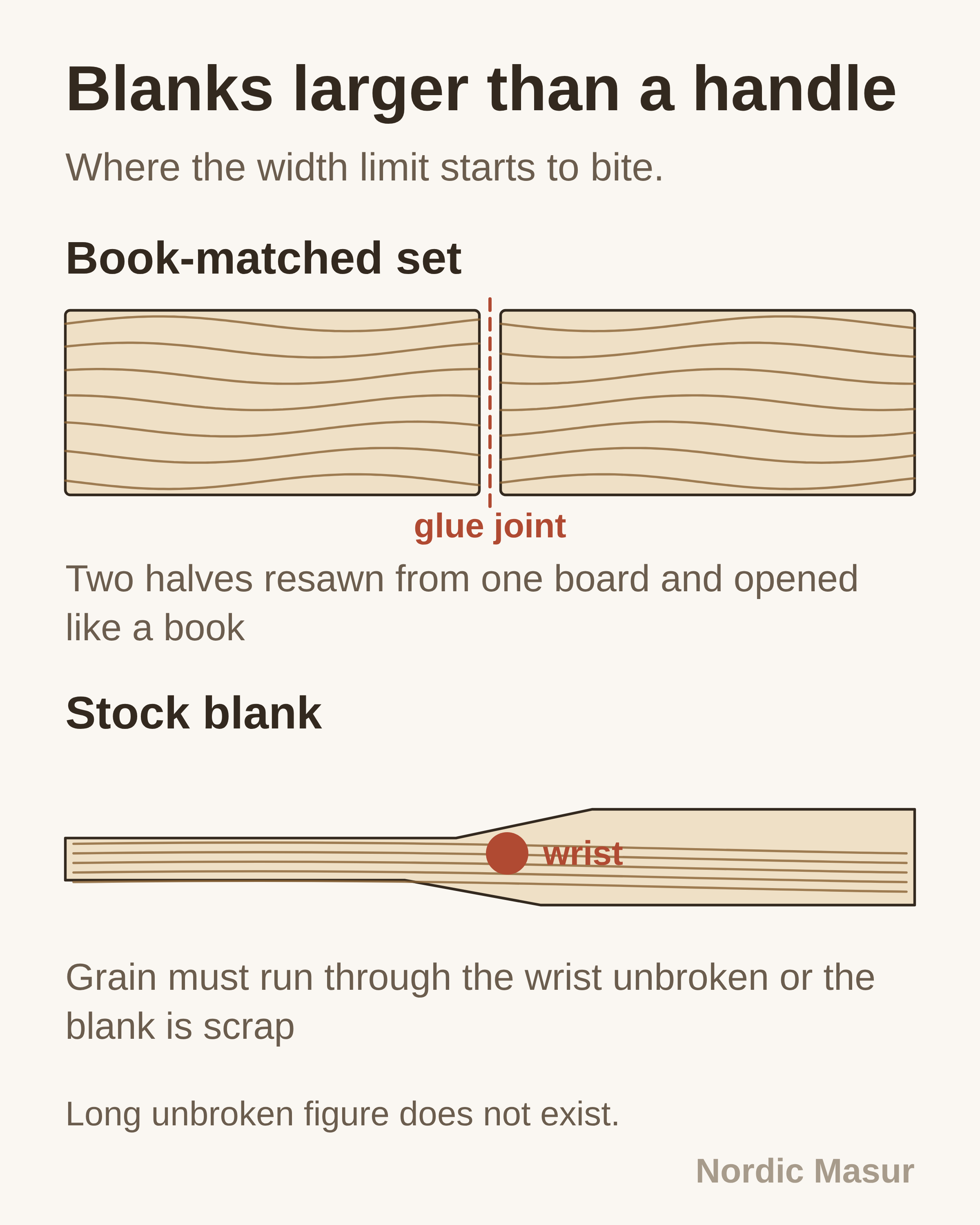
The dimensions rule it out a second time. Our boards are 10 to 25 cm wide, so a body blank means a glue-up of at least two and usually three pieces, and boards wider than about 60 cm effectively do not exist in this material at any price. Long stock with unbroken figure does not exist either, so a matched one-piece body is not a supply problem to be solved but a thing that is not there.
Where it works is as a cap. A book-matched drop top at 5 to 6 mm finished needs two pieces of about 175 mm width, which a maker resaws from one board, and that width sits comfortably inside what we cut, and at that thickness the weight it adds to an alder or roasted pine body is a few hundred grams rather than the kilo and a half a solid body in the same wood would cost you. This is exactly how flamed and quilted maple has been used for forty years, and figured birch does the same job with a different pattern: twisted fibre with dark inclusions of bark and parenchyma between it rather than the regular banding of curl. The layout diagram with this post shows how the large pieces come off a log and where the book-match axis sits.
It also works for headplates, control cavity covers, a laminate in a through-neck, and the small visible surfaces where nobody is asking the wood to be structural.
Where straight maple is still the better answer
For a neck, quartersawn straight-grained maple is better than figured birch and it is worth saying so plainly. A neck needs predictable longitudinal stiffness and predictable movement, and interlocked fibre gives neither. The figure that makes this wood interesting is, structurally, the fibre wandering, and a 650 mm scale length under 50 kg of string tension is not the place for a wood chosen because its fibres wander.
Dimensionally you could do it. Boards run to 1.5 m long and 15 to 50 mm thick, which is enough to cut a one-piece neck blank from. The reason not to is mechanical rather than dimensional.
Fingerboards are similar. At around 1,250 lbf on the Janka scale, curly birch is harder than plain birch at about 1,100 but softer than sugar maple at about 1,450, and a fingerboard wants to be at the hard end. It can be done, and roasted maple or a listed alternative will hold a fret slot better.
The claim not to make
There is very little evidence that body wood species determines the amplified tone of a solidbody electric, and a good deal of published measurement suggesting the effect is small next to pickups, strings, scale length and the neck joint. Anyone selling a body wood on tone, including us, should be asked for the measurement.
What wood does decide is weight, balance, how the instrument resonates acoustically in the player's hands, how it takes a finish, how it machines, and what it looks like. Those are real and they are enough. A drop top is a visual and a weight decision, and it is honest to present it as one.
Moisture, which is the part that catches instrument makers out
Our material ships at 13 to 15% moisture content. Instrument work generally wants 6 to 8%. That gap is not a detail and it is not something a week on a rack fixes.
Wood at 13 to 15% brought into a workshop held at instrument conditions will keep losing moisture for months, and a top glued at 12% onto a body at 7% will develop a glue line you can see. The correct sequence is to bring the material to your own shop's equilibrium first, measured with a meter rather than assumed, then joint and glue. On a 6 mm book-matched top that is a matter of weeks with the pieces stickered and air on both faces. On thick stock it is considerably longer, which is why most instrument makers buy figured wood a season before they intend to use it.
The wood is mainly air-dried outdoors here and finished with a kiln cycle in autumn, and from standing tree to a board we will ship is one to three months depending on the drying method. That produces stable boards at the moisture content most of our customers want, which is knife makers and turners rather than luthiers. How it is dried is described under curly birch.
If you are evaluating it
Order one book-matched pair at drop-top thickness rather than a body-sized order, put a meter on it the day it arrives and again three weeks later, and see how far it has to travel to reach your shop's equilibrium. That number tells you more about whether this material suits your build schedule than any amount of description does. Sizes as cut are under products, and what shipping from Finland involves is set out under shipping.
Working on something in curly birch?
One line is enough to start. If you already know the sizes and quantity, add them below and we can quote with photos of the actual boards.
Prefer email? Write to hello@nordicmasur.com.