Stabilised Knife Scales: What Resin Does and Doesn't Do
Stabilising pulls the air out of a piece of bone-dry wood under vacuum, lets a thin acrylic monomer take its place, and then cooks the whole thing until that monomer polymerises into a solid inside the cell structure. What you get back is a composite: wood fibre with cured plastic where the empty space was. It stops moisture movement almost completely and it raises surface hardness. It does not make the scale tougher against impact, it does not improve the glue joint, and it cannot rescue a blank that was cracked before it went in.
What the process actually involves
The wood has to be dry first, and dry here means much drier than any timber supplier ships. Home stabilising schedules put blanks in an oven at around 100°C for twenty-four hours to drive moisture toward zero, because any water left in the cells occupies space the resin needs and will flash to steam during the cure. This is the step most often shortened and it is the one that decides the result.
The dried blanks then go into a chamber submerged in the monomer, usually a methacrylate-based resin with a heat-activated catalyst mixed in, and vacuum is drawn. Air comes out as a stream of bubbles and goes on bubbling for an hour or more on a piece of any size. When it stops, the vacuum is released and atmospheric pressure pushes resin into the space just evacuated. The blanks soak, sometimes overnight, then cure wrapped in foil at around 90°C.
Professional operations add pressure and use proprietary resins, which is why commercially stabilised blanks are better impregnated than home-stabilised ones. That difference is real and a better vacuum pump does not close it.
The measure of success is weight gain, so weigh before and after rather than guessing. A light, open wood can gain a third to two-thirds of its own weight; a dense one gains very little, because there was little air in it to replace.
Which woods take it, and which do not
Density decides almost everything. Punky burl, spalted maple, buckeye and box elder are stabilised as a matter of course, because without resin they are too soft to hold a chamfer on a handle. At the other end, desert ironwood, African blackwood and lignum vitae are almost never stabilised: there is no accessible void space, the resin stops a millimetre in, and the oil content already made them stable.
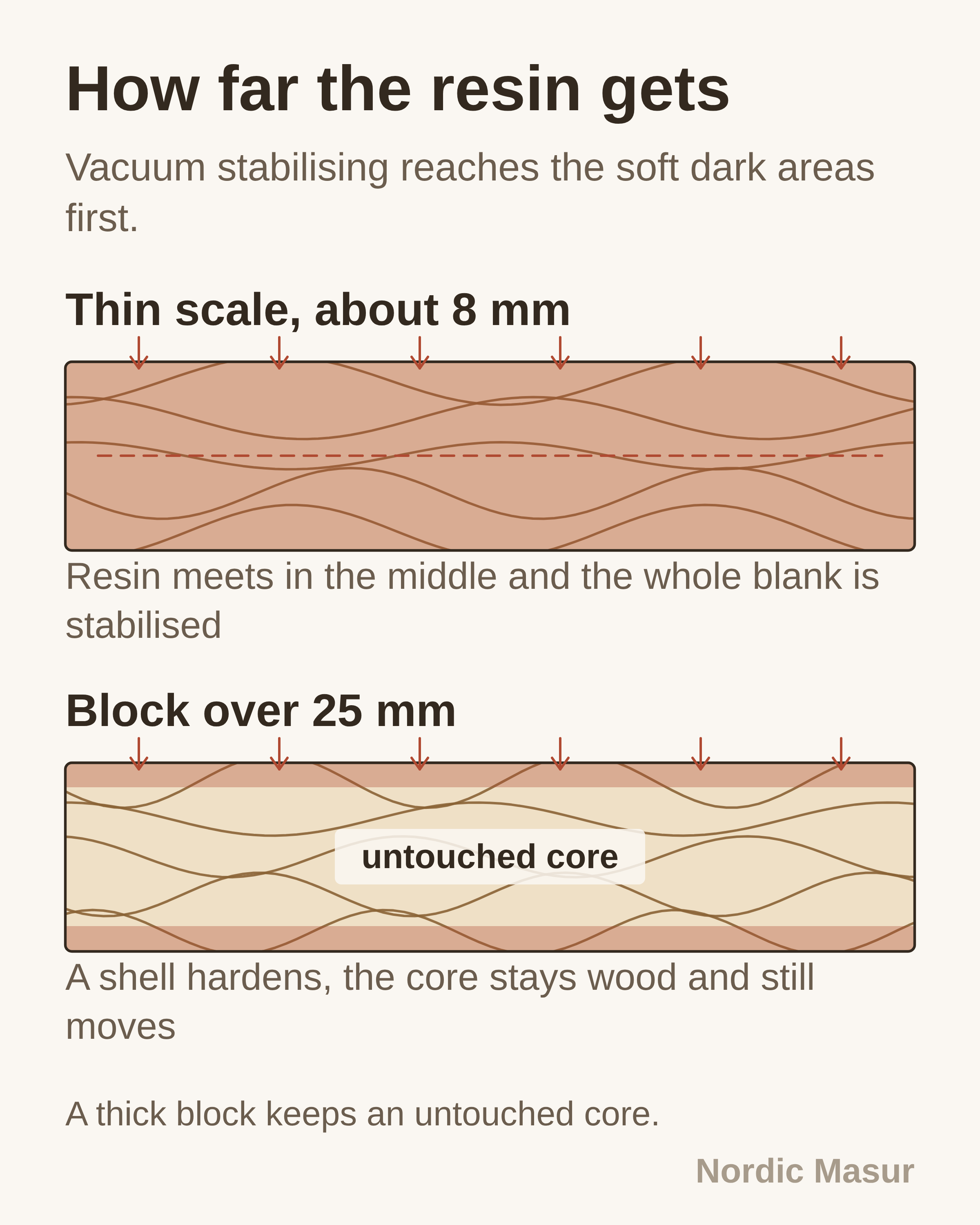
Curly birch sits in the middle. At 0.65 to 0.68 specific gravity against about 0.60 for plain silver birch, it is moderately dense, and it will take resin, though not in the quantities a soft burl does. The dark inclusions of bark and parenchyma running between the twisted fibres behave differently from the pale ground and absorb at their own rate. The penetration diagram with this post shows where resin reaches in a figured birch section and where it stops, which is the part most descriptions of the process leave out.
What stabilising genuinely fixes
Moisture movement is the main one, and on a knife it is the failure that matters. A scale glued to a tang cannot move without the joint showing it, and every proud edge, standing pin and gap at the bolster on an old handle is that movement made visible. Fully impregnated wood moves so little that the problem effectively disappears, which is why stabilised scales are standard on knives sold into climates the maker cannot predict.
Surface hardness is the second. A stabilised soft wood takes a crisp 45° chamfer and holds it, sands to a high polish without the fibre tearing, and buffs closer to a synthetic than to wood.
The third is dyeing. Colour goes into the resin rather than onto the surface, so it penetrates uniformly and does not sand through at the edges, and nearly all coloured wood scales on the market are dyed during stabilising.
And it widens what is usable. Material that would otherwise be firewood, spalted to the point of softness or riddled with punky patches, becomes a legitimate handle once it has resin in it.
What it does not fix
It does not make a scale meaningfully harder to break. Cured acrylic is brittle, and impact toughness in a handle comes from fibre continuity, not from filling the voids. A stabilised scale dropped on concrete breaks about as readily as an unstabilised one of similar density.
It does not improve the glue joint, and it often makes it worse. Cured resin on the mating face gives epoxy less to key into, so the bonding surface should be freshly abraded and wiped with acetone before assembly. Skipping that is a common cause of a stabilised scale lifting at the butt.
It does not fill voids or bark inclusions. Resin under vacuum travels through cell structure, not across an open cavity. A blank with a void in it comes out with the same void, and filling that is a separate casting operation with thickened epoxy.
It does not repair a crack. Wood that went in checked comes out checked with resin in the check, which is arguably worse, because the flaw is now locked in and no longer moves.
It does not make the handle waterproof as an assembly. Water still reaches the tang through the pin holes and along the front of the scale, and a stabilised handle on a poorly sealed tang still lets a blade rust from the inside.
And it changes the look. Resin raises the refractive index of the surface layer, which mutes the contrast between the pale ground and the dark figure in birch and gives the piece a faintly plastic depth. Some makers prefer it. It is not neutral and it is irreversible, so test one before sending a set.
When curly birch needs it and when it does not
For a pocket knife, a kitchen knife, a hunting knife or a puukko used and stored in a temperate climate, unstabilised curly birch has been the standard for generations and needs nothing. It is hard enough at about 1,250 lbf on the Janka scale, the interlocked fibre resists splitting along the handle, and it takes an oil finish that repairs invisibly. Our boards ship at 13 to 15% moisture content, so the sensible step is to let them sit in the workshop for a week or two and glue at whatever the wood settles to.
We do not stabilise, we do not stabilise to order, and we do not sell stabilised stock. What leaves here is sawn wood at its natural density. If your knife needs resin in it, the wood goes to a stabilising service after it leaves us, and that is a straightforward thing to arrange.
Stabilising earns its place when the knife will be immersed regularly, when it is going to a climate very different from the one it was built in, when the piece is unusually thin, or when the maker wants a colour. It is not a quality upgrade and it does not change the strength ranking between our grades, which are dried in the same cycle to the same moisture and differ only in how dense and even the figure is.
If you plan to stabilise, cut your blanks slightly oversize, because the oven-drying step at the start will move them before the resin locks anything. A conventional full-tang pair is around 130 × 45 × 25 mm, resawn from one block so the two faces mirror each other, and you resaw that block out of a board: ours run 10 to 25 cm wide, 15 to 50 mm thick and 0.5 to 1.5 m long, cut to the thickness you ask for, so a board at 25 or 26 mm arrives ready for the operation. Sizes are under products, and the structure behind the figure is described under curly birch.
Working on something in curly birch?
One line is enough to start. If you already know the sizes and quantity, add them below and we can quote with photos of the actual boards.
Prefer email? Write to hello@nordicmasur.com.