Spindle or Faceplate: Grain Orientation in Figured Birch
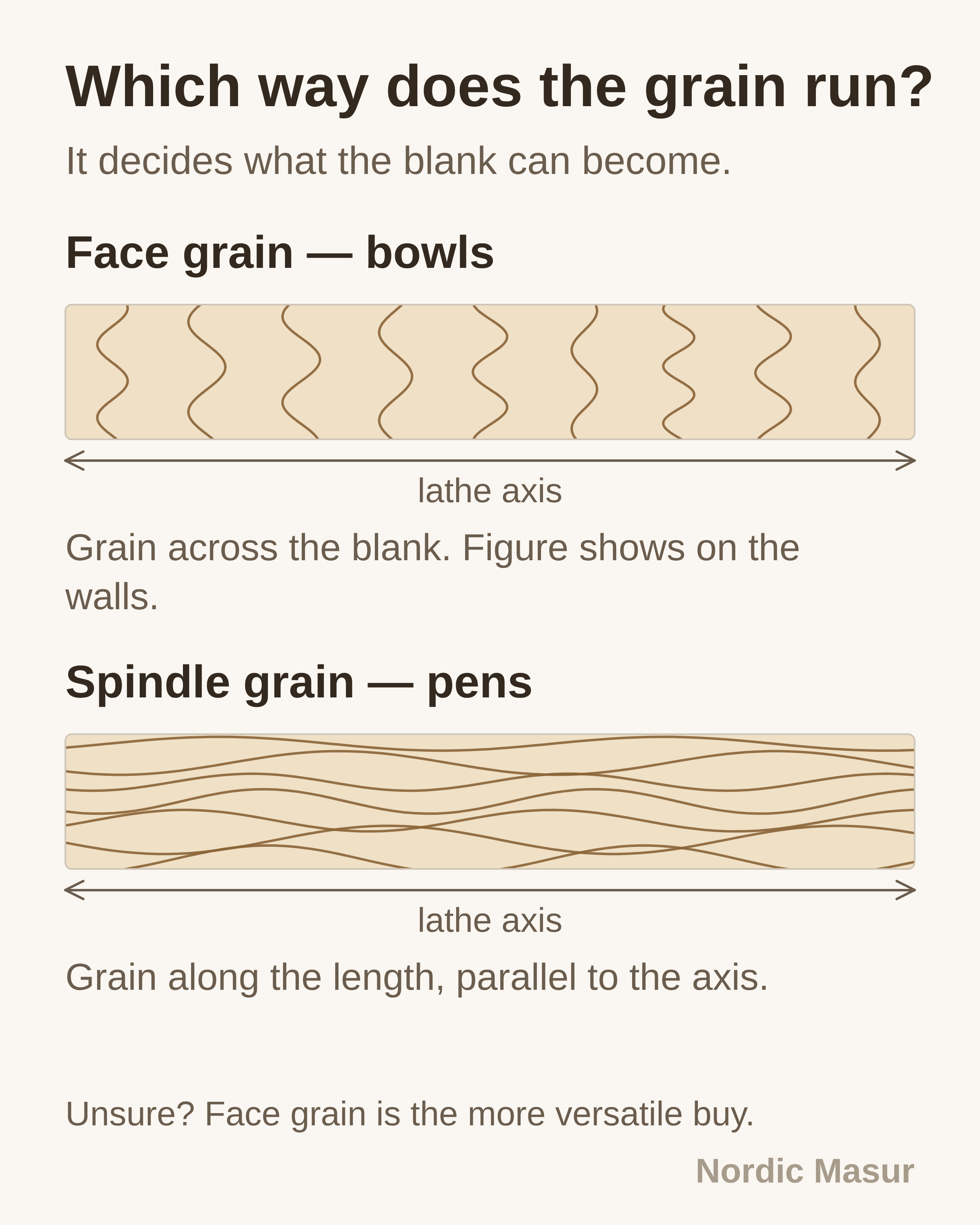
Spindle orientation means the grain runs along the lathe axis; faceplate orientation means it runs across it. That one choice decides where the end grain lands on the finished piece, which direction the piece will move as it dries, which way you have to cut to avoid tearing, and how the figure will be displayed. In figured birch all four of those consequences are larger than in plain wood.
The decision is made when the log is opened, not when the blank goes on the lathe. We sell logs, slabs and boards rather than ready-cut blanks, so that decision is mostly yours, made on your own saw, and what you order has to leave it open.
What each orientation does to the piece
In a spindle-oriented piece the end grain sits at the two ends, on the faces you usually do not see. The long grain wraps around the entire visible surface. The piece shrinks very little along its length and more across its diameter, so a spindle turning goes slightly oval in section and stays the same length.
In a faceplate-oriented piece the end grain appears twice on the visible surface, at opposite sides of the bowl, travelling through every intermediate orientation between them. The piece shrinks across the grain in one direction and much less in the other, so a bowl goes oval across the rim. That is why a green-turned bowl is a different object a month later.
The grain orientation diagram on this post shows both cut out of the same log section, which makes the trade-off obvious in a way a description does not: the two orientations compete for the same wood, and cutting one forecloses the other.
Where each one belongs
Spindle orientation is for anything held between centres and anything long: tool handles, knife handles, chair spindles, goblets, pens, bottle stoppers, honey dippers. It is also the orientation for a lidded box, because lid and body come from the same blank end to end and the grain then matches across the joint.
Faceplate orientation is for bowls, platters, dishes, shallow cups and anything wide relative to its depth. It is the only way to get a wide piece out of a stem of modest diameter, because the width of the piece is the width of the log rather than the length of it.
There is a middle case. An end-grain bowl, turned from a spindle-oriented blank, has end grain in the base and long grain all around the wall. It moves less, cuts differently, and suits deep narrow vessels such as a beaker or a lidded box. It also tears easily in figured wood, because the whole interior cut works into end grain.
Which way the figure reads
This is the part specific to figured wood, and it is why the decision is worth thinking about rather than defaulting.
Curly birch figure comes from fibre that twists and interlocks, with dark bands of bark and parenchyma laid in between the twists. Cut across those bands and you get short dark flecks and ripples; cut along them and you get longer streaks.
A spindle-oriented piece turned to a cylinder shows the figure as bands running around the circumference, tightening and loosening along the length. A faceplate-oriented bowl shows the figure as a pattern radiating from the centre of the base and changing character four times as it travels around the rim, because the surface passes through every grain orientation. The rim of a bowl in this species is frequently its best feature for exactly that reason.
Neither is better. But a maker who wants a handle to look uniform along its length and a maker who wants a bowl rim to be dramatic are asking for wood cut two different ways out of the same tree.
Cutting direction, which follows from orientation
The rule is always to cut downhill on the fibre, meaning from the supported wood towards the unsupported end, and what counts as downhill depends entirely on orientation.
- Spindle work: cut from the larger diameter towards the smaller. On a bead, work from the top of the bead down both sides. On a cove, work from the rim down into the bottom, from both sides.
- Faceplate work, outside of a bowl: cut from the base towards the rim.
- Faceplate work, inside of a bowl: cut from the rim towards the centre.
- End-grain hollowing: cut from the centre outwards, which is the reverse of the faceplate rule and the source of a lot of confusion.
In straight-grained wood, going the wrong way gives a rough surface that sands out. In curly birch it lifts a chip below the finished line, and that is not recoverable by sanding. More on how the wood behaves under an edge is on the curly birch page.
Movement, and what it does to fitted work
A spindle-oriented box body and lid, cut from the same blank, shrink together and stay round relative to each other. A faceplate-oriented lid on a spindle-oriented body will fit in the workshop and jam or fall out three months later, because one is shrinking across the grain while the other is shrinking along it.
Our slabs and boards are dispatched at 13 to 15 percent moisture content, and a heated workshop pulls them down towards 7 or 8 percent over some weeks. That drop is where the movement happens. For anything fitted, let the stock equalise in the workshop before you cut it, and turn both parts from the same piece in the same orientation on the same day.
Figured birch adds one complication. The interlocked fibre means the tangential and radial directions are not consistent across a piece, so movement is less predictable than in straight wood. In practice it moves somewhat less than you would calculate from published birch shrinkage figures, because the interlocked zones restrain each other, but it moves less evenly. Fitted work in this species wants a slightly looser fit than you would leave in plain birch.
Cutting and ordering for the orientation you want
The blanks are yours to cut, so mark the orientation on every piece as it leaves the saw. Three numbers on a face tell you nothing: the convention that the last figure runs along the grain is a convention, not a guarantee, and a photograph of a sawn face will not tell you which you are looking at a month later.
Work out which orientation the piece needs before you buy, because the two want different things from us. Faceplate work wants a log, since the width of the bowl is the width of the log: ours run 13 to 25 cm in diameter and 0.5 to 1.5 m long, green or air-dried. Spindle work wants a board, where the grain already runs the length: 10 to 25 cm wide, 15 to 50 mm thick, cut to the thickness you specify. What we cut is under products.
Say what the piece is as well as the dimensions. A sawyer told the wood is becoming a lidded box will cut it so the lid and the body come out of one length; a sawyer given three numbers cuts for the numbers. And if you need several pieces in one orientation from the same log so the figure matches across a set, that has to be asked for before the log is opened, so send it with the first enquiry through contact.
Working on something in curly birch?
One line is enough to start. If you already know the sizes and quantity, add them below and we can quote with photos of the actual boards.
Prefer email? Write to hello@nordicmasur.com.