Pen Blanks: Why Figure Reads Better Small
A pen barrel is about 55 mm long and 12 mm across, and a figure that looks sparse across a 200 mm bowl face fills that surface completely. Scale is why figured wood is at its best in small work: the pattern stays the same size while the object gets smaller, so the density of what the eye sees goes up. A board a bowl turner would reject as too unevenly figured is often the best pen stock in the stack, because any one 20 mm square cut from it lands in a busy zone.
We do not sell pen blanks. We saw curly birch into logs, slabs and boards, and the pen turner cuts blanks out of a board. That is mostly an advantage: you see the figure on the full face before deciding where the saw goes, and a pen blank is small enough to place on the part of the board worth using.
The scale argument, in numbers
Curly birch figure repeats on a cycle of roughly a centimetre to a few centimetres, depending on how tight the growth was. Across a 180 mm bowl that is ten or fifteen repeats spread over a large curved surface with plain wood between them. Across a 55 mm barrel it is three or four repeats packed into a cylinder the eye takes in at a glance. The barrel is also turned small, so the surface cuts across the figure at a steep angle and exposes more of the dark inclusions per unit area. The same board yields a restrained bowl and a busy pen.
This is why the grade that matters for pens is not the one that matters for a bowl. All three grades dry in the same cycle to the same moisture and are equally strong; only the figure differs. Even figure is what a large flat surface needs, while a pen barrel needs dense figure somewhere in a 20 mm square and nothing more. Standard grade, 40 to 50 percent of what we cut, is frequently the better buy for pen work than Premium at 10 to 15 percent. The grades are under grades.
Standard sizes and how many you get
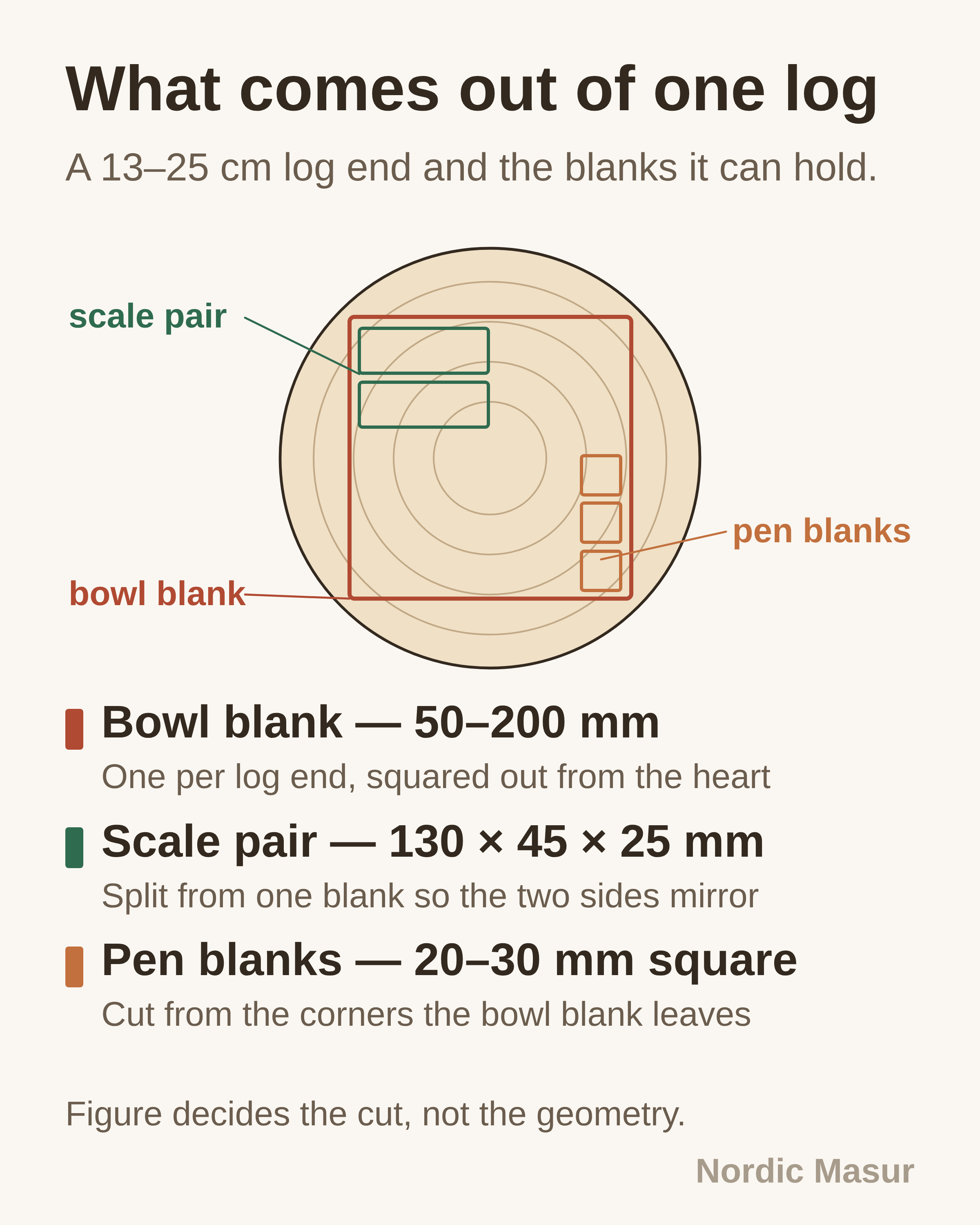
The conventional pen blank is 20 × 20 × 130 mm, sometimes 19 or 22 mm square, and 130 mm covers a two-barrel kit with kerf to spare. Larger kits, bottle stoppers and seam rippers take 25 to 30 mm square. Slimline kits work from 18 mm square, though the wall over the brass tube is then thin enough that any drift in drilling shows. Those are maker's conventions rather than product lines, and nothing stops you cutting to what your kit wants.
Our slabs and boards come 10 to 25 cm wide, 15 to 50 mm thick and 0.5 to 1.5 m long, and that is what the blanks come out of. The arithmetic is worth doing before you order. A 25 mm board gives one row of 20 mm blanks across its thickness once a clean-up pass is off each face, and a 50 mm board gives two; across a 20 cm width you get seven or eight strips after kerf. A metre of 25 mm board crosscut at 130 mm is therefore around fifty blanks, and double that from 50 mm stock. Rip the strips full length first, crosscut last, and chalk the good zones on the face before any of it.
The yield diagram on this post shows what comes out of a log once the pith, the sapwood and the end checks are removed. Pen blanks are the most efficient use of figured wood there is, because they come out of offcuts, around defects and out of lengths too short for anything else.
Orientation, and what you are choosing between
Grain running along the length of the blank is the default and what pen barrels are almost always turned from. The figure then runs up the barrel and reads as a continuous pattern from nib to cap. Cutting across the grain gives concentric rings instead; those blanks are harder to drill without blowout, harder to keep on centre and more prone to splitting when the tube is glued. Decide which you want before the board is on the saw.
For two barrels of one pen to match, cut them end to end from the same strip and keep them in order. Number the ends in pencil as they come off the saw, because a box of unmarked blanks is a box of unmatched blanks.
Drilling and gluing, where blanks are lost
More pen blanks are destroyed at the drill press than on the lathe, and figured wood loses more of them than plain wood does.
- Drill on the lathe with the blank in a chuck if you can, because the hole is then concentric with the axis and wander in the bit does not matter.
- On a press, use a pen-blank vice rather than a machine vice, and check the blank is vertical in both planes.
- Peck frequently and clear the swarf. A brad point bit loaded with dust generates real heat, and heat in an interlocked blank opens a split along the fibre.
- Back the exit face with a sacrificial block. Interlocked fibre lifts a chip off the face rather than blowing out in a clean cone, and the chip is always on the side you wanted to show.
Once the hole is good, scuff the brass, clean it with acetone or methylated spirit and let it dry. Medium CA or two-part epoxy both work; epoxy gives more working time and fills better in a hole with a slightly wandering wall, which figured birch tends to produce. Put the adhesive on the tube rather than into the hole, insert with a twisting motion, and wet the whole tube, because a dry patch under the barrel is where a split starts when it is turned thin.
Sawn stock is dispatched at 13 to 15 percent and keeps losing moisture in a heated workshop down towards 7 or 8 percent. A blank glued to a brass tube cannot shrink, so one glued straight out of the box has been under tension ever since. Let the board sit in the workshop for a fortnight before you cut and glue. This is the commonest cause of hairline cracks appearing along a finished barrel months later.
Turning and finishing
Turn on a mandrel, or better between centres with the bushings only as a size reference. Take light cuts with a skew or a small spindle gouge and expect the same fibre reversals as in any figured wood, at a smaller scale. Sand through the grits with the lathe off between them, wiping along the grain, because circular scratches show on a barrel this size under gloss.
Curly birch takes a friction polish or a CA finish well. At a specific gravity of 0.65 to 0.68 against about 0.60 for plain birch, finish stays near the surface and the dark inclusions come up darker once anything is applied. Judge the figure with a wiped-on coat, never dry.
What to order
Work out how many blanks you need, run the arithmetic above, and ask for the board thickness that gives whole rows rather than a remainder. A board at 44 mm yields two clean 20 mm rows with kerf and clean-up allowed for, and asking for a specific thickness costs nothing, because we cut to what you ask with the allowance you want. Say what the board is for, since a board chosen for pens is a different board from one chosen for a tabletop. Board dimensions are under products, and how the wood behaves under an edge is on the curly birch page.
Working on something in curly birch?
One line is enough to start. If you already know the sizes and quantity, add them below and we can quote with photos of the actual boards.
Prefer email? Write to hello@nordicmasur.com.