Moisture Content for Figured Hardwood
The right moisture content for a piece of wood is the equilibrium moisture content of the place the finished object will live, and nothing else. There is no universal correct number, which is why the figures quoted in books contradict each other: a workshop in Arizona and a workshop in Galway are both right about their own wood and both wrong about each other's.
Figured wood adds a second problem on top of that one. Because the fibre direction changes repeatedly within a single piece, the movement in it is not cleanly tangential in one axis and radial in the other. Both happen at once, in patches, pulling against each other.
Work out your own target before anything else
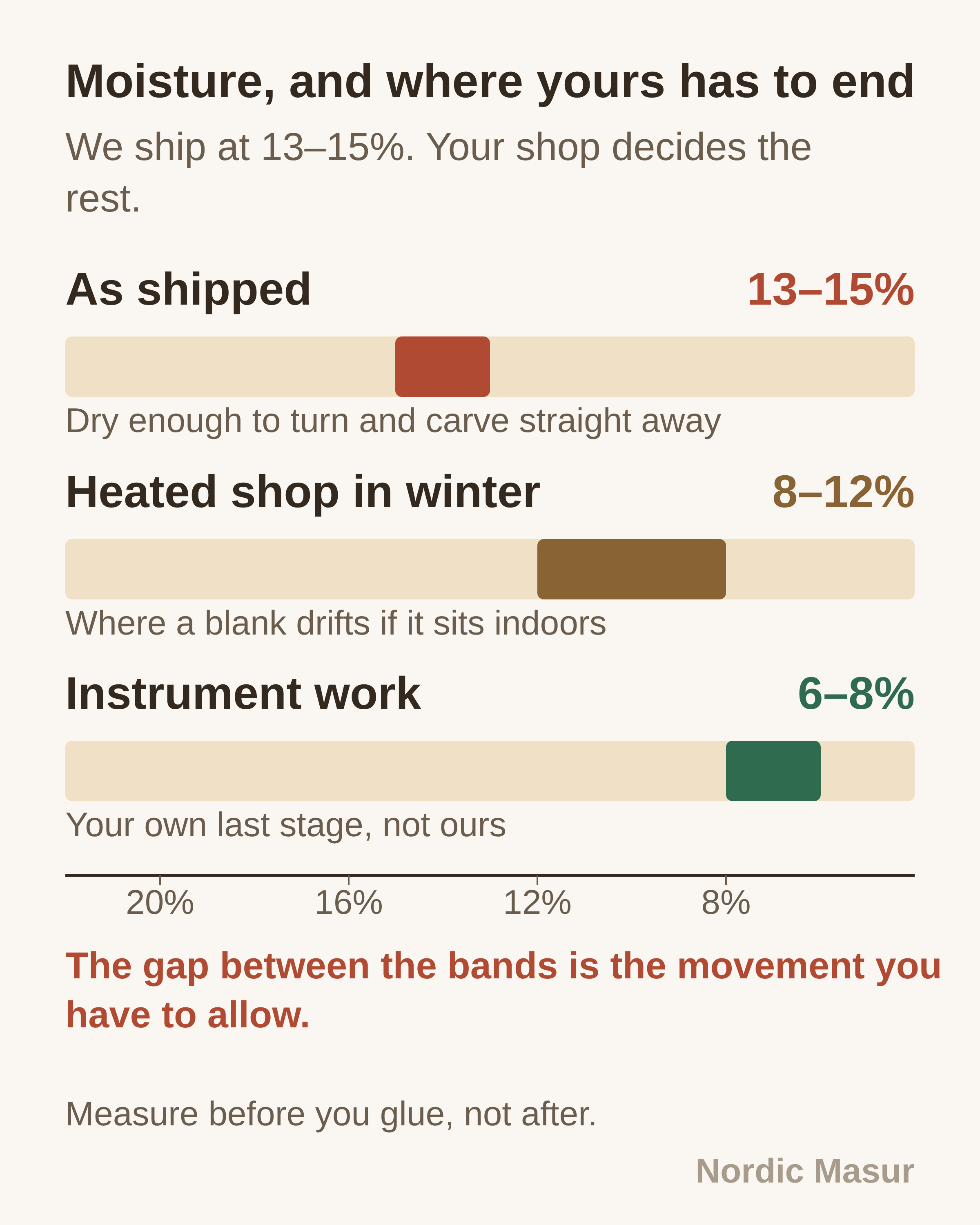
Wood reaches equilibrium with the air around it, driven mostly by relative humidity and only slightly by temperature. A usable approximation in the middle of the range is that equilibrium moisture content is roughly relative humidity divided by five. At 30% RH, which is a centrally heated house in a cold winter, that gives about 6%. At 45% it gives about 9%. At 65%, an unheated stone workshop in a wet climate, it gives around 13%.
That approximation is enough to set a target. Better still, buy a cheap hygrometer, leave it in the room the object will end up in, and read it across a year rather than a week, because the number that matters is the annual swing and not today's value. A piece built for a room that runs 35% in February and 60% in August has to tolerate roughly 7% to 12%, and the sensible build moisture is somewhere in the middle of that rather than at either end.
Typical targets that follow: 6 to 8% for instruments and for furniture going into dry centrally heated interiors, 9 to 11% for furniture in temperate maritime conditions, 12 to 15% for anything living in an unheated outbuilding or outdoors under cover. Our slabs and boards leave at 13 to 15% moisture content, which is right for the northern European outdoor and unheated use most of them go to, and too wet for a heated shop without conditioning. Logs go out green or air-dried, whichever the buyer asks for, and a green log is a different proposition entirely.
Measuring it without fooling yourself
Resistance meters push two pins into the wood and measure conductivity between them. They are accurate in the range that matters, they need a species correction and a temperature correction applied, and they read the wettest path between the pins rather than an average. On a piece with a damp core they will read the core if you drive the pins deep, and the surface if you do not, which is a feature rather than a fault once you know it.
Pinless meters read capacitance over a depth of roughly 20 mm and need the wood's density entered. This is where figured wood catches people out. Curly birch runs 0.65 to 0.68 specific gravity against about 0.60 for plain silver birch, so a meter left on a birch setting will read low on this material, by enough to matter when you are deciding whether to glue.
The shell and core question is the one that causes real failures. A 45 mm piece can sit at 9% for the outer 5 mm and 14% in the middle, and both meters will tell you what they are looking at rather than what the piece is. The direct check is to crosscut a piece, read the fresh face immediately, and compare it with the surface reading. If you need a number you can trust completely, the oven-dry method is the reference: weigh a sample, dry it at about 103°C until the weight stops falling, and moisture content is the weight lost divided by the final dry weight, as a percentage. It destroys the sample and it settles the argument.
Why figured wood moves differently
Wood shrinks roughly twice as much along the growth rings as across them. In birch the tangential figure is around 9% and the radial around 5% from green to oven dry, and since fibre saturation sits near 28 to 30%, the practical rate is about a third of a percent of dimension for each percentage point of moisture change tangentially and about half that radially.
In straight-grained wood those two directions are consistent along the whole board, which is why flatsawn boards cup predictably and quartersawn boards do not. In curly birch the cambium divides unevenly, the fibres twist and interweave, and dark inclusions of bark and parenchyma are laid between them. The result is that a single face contains patches behaving tangentially next to patches behaving radially, all shrinking at their own rates and restraining each other.
Three things follow. Figured stock cups and twists in ways that do not correspond to the growth ring orientation you can see on the end grain. It develops internal stress that is released the moment you resaw, which is why a resawn slab that came off the saw flat will have moved by the next morning. And it checks more readily than plain stock if it is dried fast, because the stresses have nowhere to equalise. The movement diagram with this post shows the two directions and what acclimatising actually changes.
The practical response is to machine in stages. Rough out oversize, sticker the pieces with air on both faces, leave them three to seven days, then flatten and dimension. Doing it in one pass means doing it twice, and the second time you will not have the margin.
What to do with material that arrives at 13 to 15%
Do not try to accelerate it. Wood brought down quickly from 14% to 7% will check, and a checked figured piece cannot be recovered because the crack follows the inclusions rather than a straight line you could cut out.
Sticker the pieces in the space where they will be worked, with a few millimetres of air on every face, out of direct sun and away from a radiator. Weigh one piece or meter it weekly. What you are waiting for is not a target reading but two readings a week apart that are the same, which means the piece has stopped moving and is at equilibrium with that room. On a 25 mm board that is usually two to four weeks. On a 45 mm block cut for turning it can be several months.
If you are in a hurry and the piece is small, roughing it oversize first speeds everything up, because moisture leaves a 30 mm section far faster than a 60 mm one. That is the whole logic behind rough-turning a bowl and coming back to it.
Where to start
Put a hygrometer in the room the finished object will live in before you order anything, and get a real number rather than an assumption. Then order with the understanding that material at 13 to 15% is a starting condition and not a finished one, and build the conditioning time into the schedule rather than into the excuses.
How the wood is dried, mainly air-dried outdoors and finished with a kiln cycle in autumn, is described under curly birch. What we cut is under products, and since we cut boards to the thickness you ask for, and thickness is the single biggest factor in how long conditioning takes, that is a number worth choosing deliberately rather than taking the nearest stock size. What to expect from a consignment crossing from Finland is set out under shipping.
Working on something in curly birch?
One line is enough to start. If you already know the sizes and quantity, add them below and we can quote with photos of the actual boards.
Prefer email? Write to hello@nordicmasur.com.