Knife Scale Blanks: Dimensions, Pairing, Grain Matching
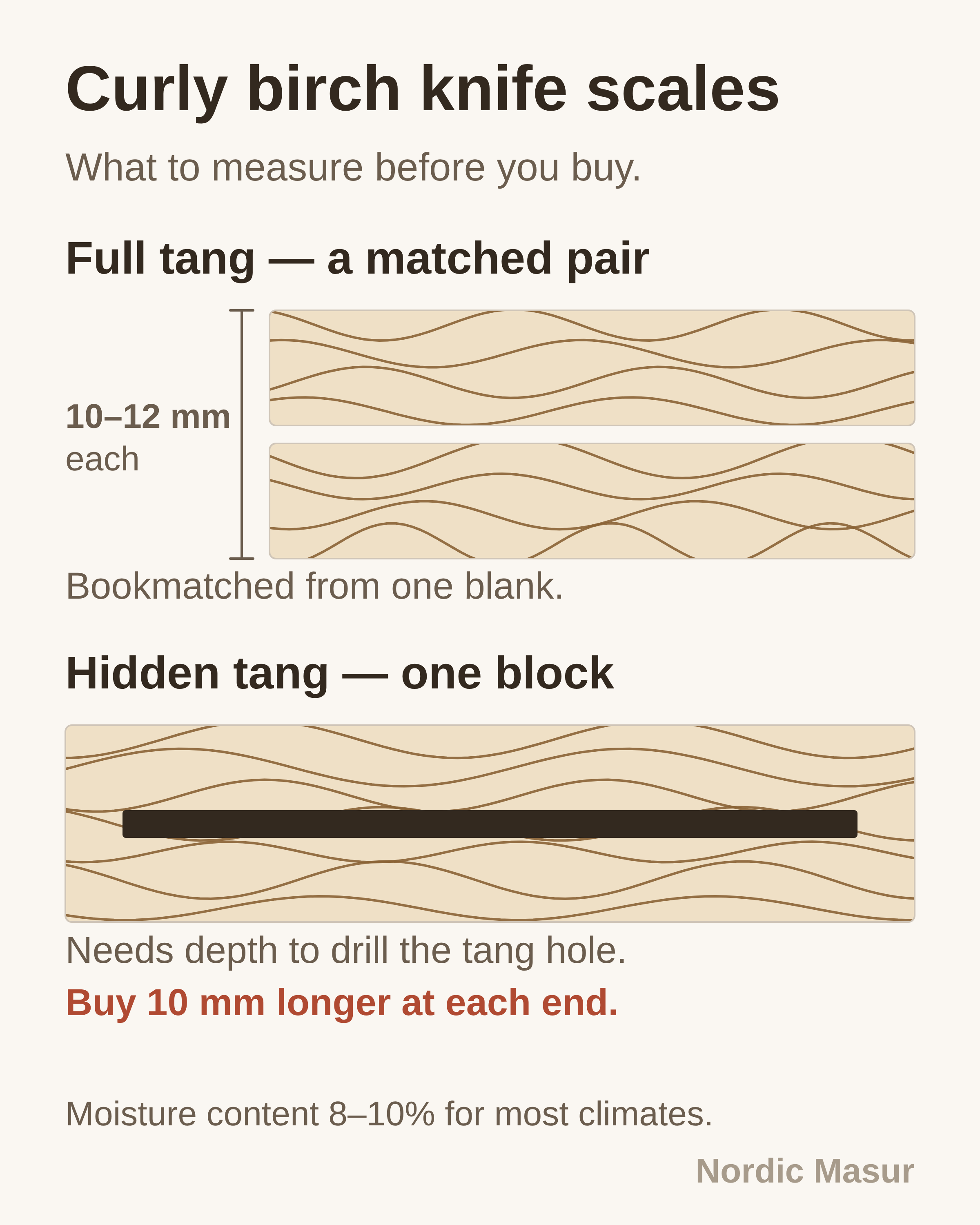
The conventional full-tang scale pair is around 130 × 45 × 25 mm, resawn from a single block so that the two sides mirror each other. That is one block opened, not two pieces picked to look similar, and the difference between those two things is the whole subject of matching.
That convention is a maker's dimension rather than a product. We sell curly birch as boards and logs, not as scale pairs, so the block and the resaw are yours, and the only thing that has to be right at the order stage is the board thickness, because a board cut too thin cannot be made thicker. Everything below is how to work from a board to a pair that actually mirrors.
For a hidden tang handle the requirement is different: one block rather than a pair, and enough thickness to take the tang through the middle of it.
Sizing a full-tang pair
Work backwards from the finished handle. A typical finished scale is 6 to 8 mm thick per side, 110 to 125 mm long and 30 to 40 mm at its widest. From a 25 mm block resawn down the middle you lose 1.5 to 3 mm to the kerf, leaving about 11 mm of usable thickness per side, so roughly 3 mm of margin for flattening on each scale. That sounds generous and is not, because a resawn slab rarely stays flat.
Add 5 mm at each end and 3 to 5 mm on the width beyond the finished shape. The overhang is not waste; it lets you position the handle profile on the part of the figure you want to show, which on figured wood is a real decision.
If you intend to send the blanks out for stabilising, add more, because the oven-drying step at the start takes the wood to near zero moisture and moves it. We do not stabilise and do not sell stabilised stock, so that is a separate job with a separate supplier.
Resawing and the mistake almost everyone makes once
Resaw the block through its thickness, so you open it into two slabs. The two newly cut faces are a near-mirror image of each other, because they were adjacent in the tree and the figure runs through the piece rather than across it.
Those matched faces have to end up on the outside of the handle. That means the original outer faces of the block become the glue faces, and all of your flattening and thinning happens on the sides that were showing before the resaw. Glue the freshly cut faces to the tang and the match is gone: the visible surfaces are then two faces that were 25 mm apart in the wood, and on strongly figured material 25 mm is enough for the pattern to be noticeably different.
The second point is timing. Resawing releases internal stress, and a slab that came off the bandsaw flat often cups within a day. Cut, sticker with air on both faces, and leave three to seven days before final flattening. Flattening straight after the cut means doing it twice.
Book-match, slip-match and what they look like on a knife
A book-match mirrors the pattern across the centreline, so the two sides of the handle are mirror images when the knife is turned over. That is the traditional and usually the right choice, and the only match that reads as symmetrical in the hand.
A slip-match slides one slab along rather than flipping it, so the pattern repeats rather than mirrors. It is rarely used on a single knife and is worth knowing for sets, where four scales can look like a sequence rather than two mirrored pairs.
The third option for a batch is to give up matching and cut every scale from the same board, so the set is consistent without any two being paired. For production work this is often the sensible answer and it uses considerably more of what a log gives.
Orienting the figure
In curly birch the fibre direction changes several times across a few centimetres, so there is no single grain direction to line up. What you are orienting is the figure pattern and the end grain.
Run the length of the blank along the length of the handle. That puts end grain at the butt and the front, where it is short and supported, rather than along the spine where it would be a splitting line. The interlocked fibre already resists splitting, but there is no reason to make it work harder.
The figure reads differently on the radial and the tangential face of the same block, and which is better depends on the piece. Look at both under a raking light before deciding the show face; wood that looks unremarkable flat-on often comes alive at 30°. The dimensions diagram with this post sets out how a pair is taken out of a block and which face ends up where.
One practical detail on pin placement. A dark inclusion of bark and parenchyma sitting exactly where a pin hole goes can chip out on the drill exit. Look at the show face before you mark the holes and move the pin a couple of millimetres if you can; on most handle designs you can.
What a board actually yields
Our boards run 10 to 25 cm wide, 15 to 50 mm thick and 0.5 to 1.5 m long, cut to the thickness you ask for with the allowance you want left on. A board of 150 mm width, 30 mm thickness and one metre length cuts, in theory, into three strips across the width and seven blocks along the length, so twenty-one blocks and twenty-one pairs.
In practice you will get well under that. End checks come off both ends, sapwood on the edge of a strip is usually cut away, and figure density varies along the length, so a block from a thin stretch is one you would not want as a show face. Half to two-thirds of the theoretical count is a realistic planning figure for a first order, and it improves once you can read a board.
The way to improve on that figure is to chalk the good stretches on the face before any cut is made, lay the blocks out on the board rather than working from one end, and accept that the thin-figured sections become liner stock or offcuts for finish testing. Sizes as we cut them are listed under products.
What to say when you order
Ask for the board thickness that suits your handle, not the nearest stock size. A 25 or 26 mm board gives a conventional pair straight off the resaw; a thicker handle or a hidden tang block wants 40 or 50 mm. We cut to the thickness asked for, so there is no reason to buy thick and resaw away the difference. Say how many knives, and say explicitly whether pairs must match each other or only within themselves. Matching across a batch is the single biggest constraint on a figured-wood order and it decides which logs can be opened at all.
Say what grade you want and why. All three of our grades are dried in the same cycle to the same moisture and are equally strong, and the difference is how dense and even the figure is. A handle that will be partly wrapped in leather or birch bark does not need Premium, because you will be covering the part you paid for.
And say whether the blanks are going out for stabilising, because that changes the thickness allowance. Boards leave here at 13 to 15% moisture content; let them sit in your workshop for a week or two before you cut. If the thickness or width you need is outside what is listed, ask at the quote stage rather than cutting down a larger piece, which wastes the part of the log that was hardest to find.
Working on something in curly birch?
One line is enough to start. If you already know the sizes and quantity, add them below and we can quote with photos of the actual boards.
Prefer email? Write to hello@nordicmasur.com.