How to Tell Real Curly Birch from Regular Birch
With curly birch being scarce, it's worth knowing how to verify what you're buying. Mislabelled wood is a real problem online, and not always deliberate — some sellers genuinely don't know the difference between this and plain figured stock, whether they're calling it masur birch or Karelian birch. Here's how to tell.
How to Identify Curly Birch by the Bark
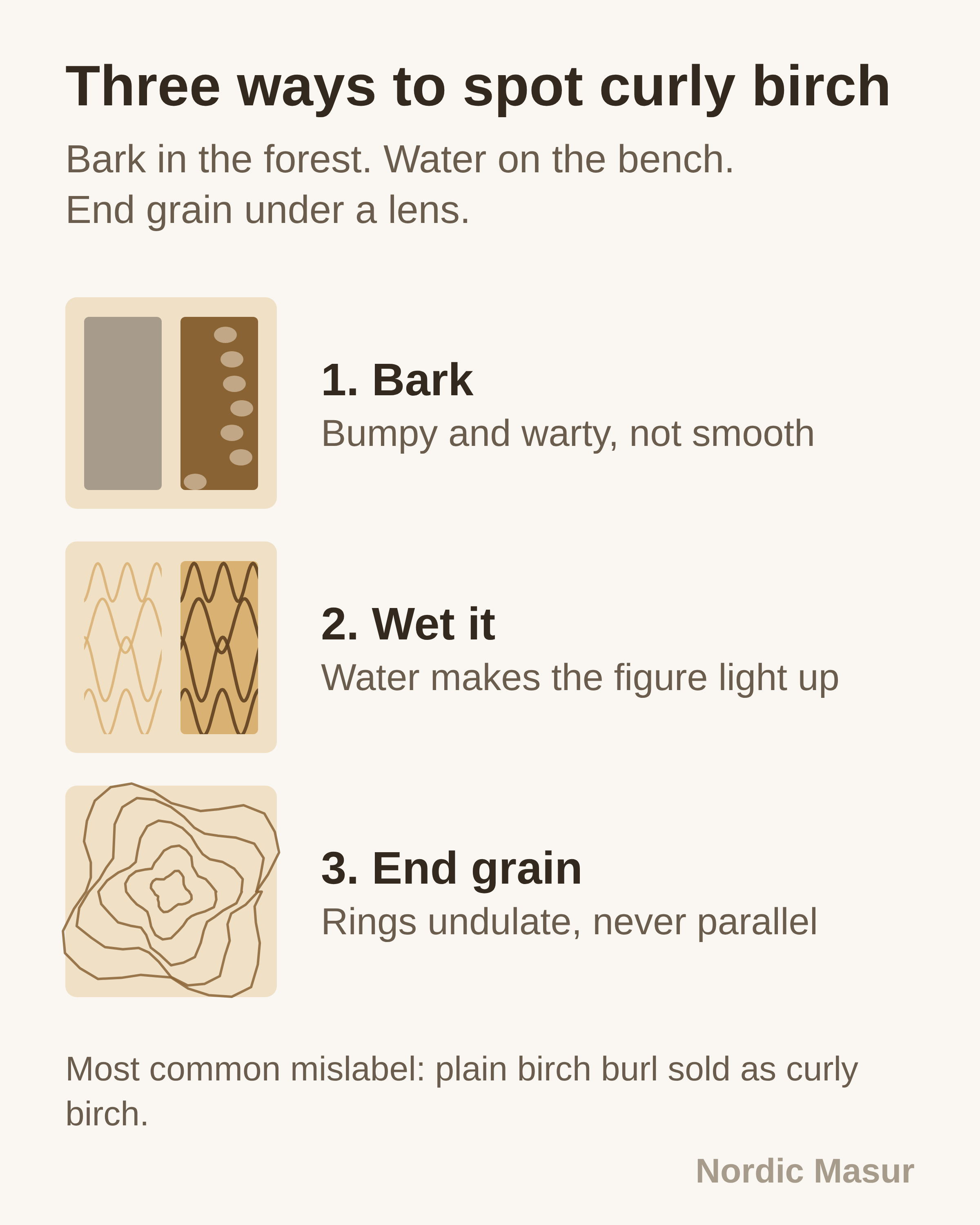
If you're looking at a log or a piece with bark still attached, the bark is distinctly different from regular birch. Silver birch has relatively smooth, white bark, though on mature trees the lower trunk gets rougher and darker. Curly birch bark is bumpy, uneven, almost warty. The bumps correspond to the irregular growth pattern underneath. It looks like the bark is struggling to contain what's happening inside the tree.
This is the quickest field identification method. Experienced buyers can spot a figured tree standing in a forest from twenty metres away, just from the bark texture.
Wet the Surface
If you have a sawn piece with no bark, the simplest test is to wet the wood. Take a damp cloth and wipe it across the end grain or any flat-sawn surface. On regular birch, you'll see straight, unremarkable grain. On curly birch, the figure lights up immediately — swirling patterns, dark and light areas, sometimes almost holographic movement.
This works because water raises the grain differentially. The interlocked fibres absorb water at different rates, making the figure visible even on a rough-sawn surface that looks plain when dry.
Check the End Grain
Look at the end grain with a hand lens or even just good light. Regular birch shows straight, parallel growth rings. Curly birch end grain is wavy and irregular — the growth rings undulate like a topographic map. In heavily figured pieces, the end grain pattern is dramatic and unmistakable.
Understand Figure Density
Curly birch comes in a range of figure densities. Light figure has scattered patches of curl amid mostly straight grain. Heavy figure is wall-to-wall swirling pattern with almost no straight grain visible. Both are genuine, and both have their place — the grade tells you which you're getting, not the name on the listing.
When buying online, be cautious of photos that show only one small area of a piece. A board with one nice patch of figure and mostly straight grain is technically the right wood, but it's not what most people are expecting. Ask for photos of all sides.
Common Mislabelling
The most frequent issue we see is plain birch burl being sold as curly birch. Burl is different — it comes from a growth deformity on the tree, not from the genetic variant that produces figure throughout the trunk. Burl can be beautiful, but it's typically more irregular, often with bark inclusions, and the pattern doesn't read the same way.
We've also seen flame birch sold as masur birch. Flame birch has parallel wavy lines, like a ripple pattern. Curly birch figure is more complex: swirling, irregular, with the characteristic eyes and whorls.
If a deal seems too good to be true, ask where the wood came from and who felled it. A supplier who can answer usually is who they say they are.
Working on something in curly birch?
One line is enough to start. If you already know the sizes and quantity, add them below and we can quote with photos of the actual boards.
Prefer email? Write to hello@nordicmasur.com.