Guitar Body and Neck Blanks: Sizing and Weight
A bolt-on body blank is about 510 × 355 × 45 mm, which is the 20 by 14 by 1¾ inch figure every supplier quotes, and a set-neck mahogany back is the same footprint at 45 to 50 mm with a separate cap on top. A one-piece bolt-on neck blank needs 735 × 90 × 26 mm as an absolute minimum and 760 × 100 × 28 mm if you want any room to move.
Those numbers matter more than they look, because they are what decide whether a given species is available to you at all. Plenty of woods that make excellent instruments cannot be had in a 355 mm width, and that constraint rather than any acoustic argument is what has shaped the standard palette.
Bodies: the footprint and what it weighs
Take the standard blank at 510 × 355 × 45 mm, which is 8.15 litres of wood before a single cut. Routing the outline, the cavities and the neck pocket removes roughly half of it, so a finished body weighs a little over half what the blank did.
Run the arithmetic on the usual species and the weight question answers itself. At about 450 kg per cubic metre, alder gives a 3.7 kg blank and a finished body a little under 2 kg. Light swamp ash at 480 to 560 gives 3.9 to 4.6 kg and a body of roughly 2 to 2.4 kg. Honduran mahogany at about 590 gives 4.8 kg, which is why a mahogany body is heavier than an alder one and why Les Paul weight relief exists. Hard maple at about 700 gives 5.7 kg, and nobody builds a solid maple body for exactly that reason.
Put curly birch through the same sum. At 0.65 to 0.68 specific gravity, so 650 to 680 kg per cubic metre, the blank would come out at 5.3 to 5.5 kg and the finished body between 2.7 and 3.2 kg. That is a maple-weight body with a birch pattern on it, and a player will notice on the second set.
The useful conclusion is the same one the industry reached with maple forty years ago. Dense figured wood belongs on top of a light body, not instead of it. A 5 mm book-matched cap over the actual body outline, not the bounding rectangle, works out at a few hundred grams. That is a cosmetic decision with a weight cost you can plan for, rather than a structural one.
Necks: thickness is the constraint, not length
For a Fender-style neck with an integral fingerboard, 26 mm of thickness is the floor and you will regret being that close to it. Allow 28 mm. The length is straightforward at 735 to 760 mm and the width at 90 to 100 mm covers the headstock.
The moment the headstock is angled, thickness becomes the whole problem. A one-piece angled headstock in the Gibson style needs enough thickness to contain both the neck shaft and the headstock plane at 13 to 17°, which is why set-neck stock runs at 50 mm and above and why the alternative is a scarf joint. A scarf-jointed neck uses a fraction of the wood, is arguably stronger across the headstock transition because the fibre runs the right way through it, and is treated as a compromise mainly for historical reasons.
If a separate fingerboard is going on, the neck blank drops to 22 to 24 mm and a much wider range of stock becomes usable.
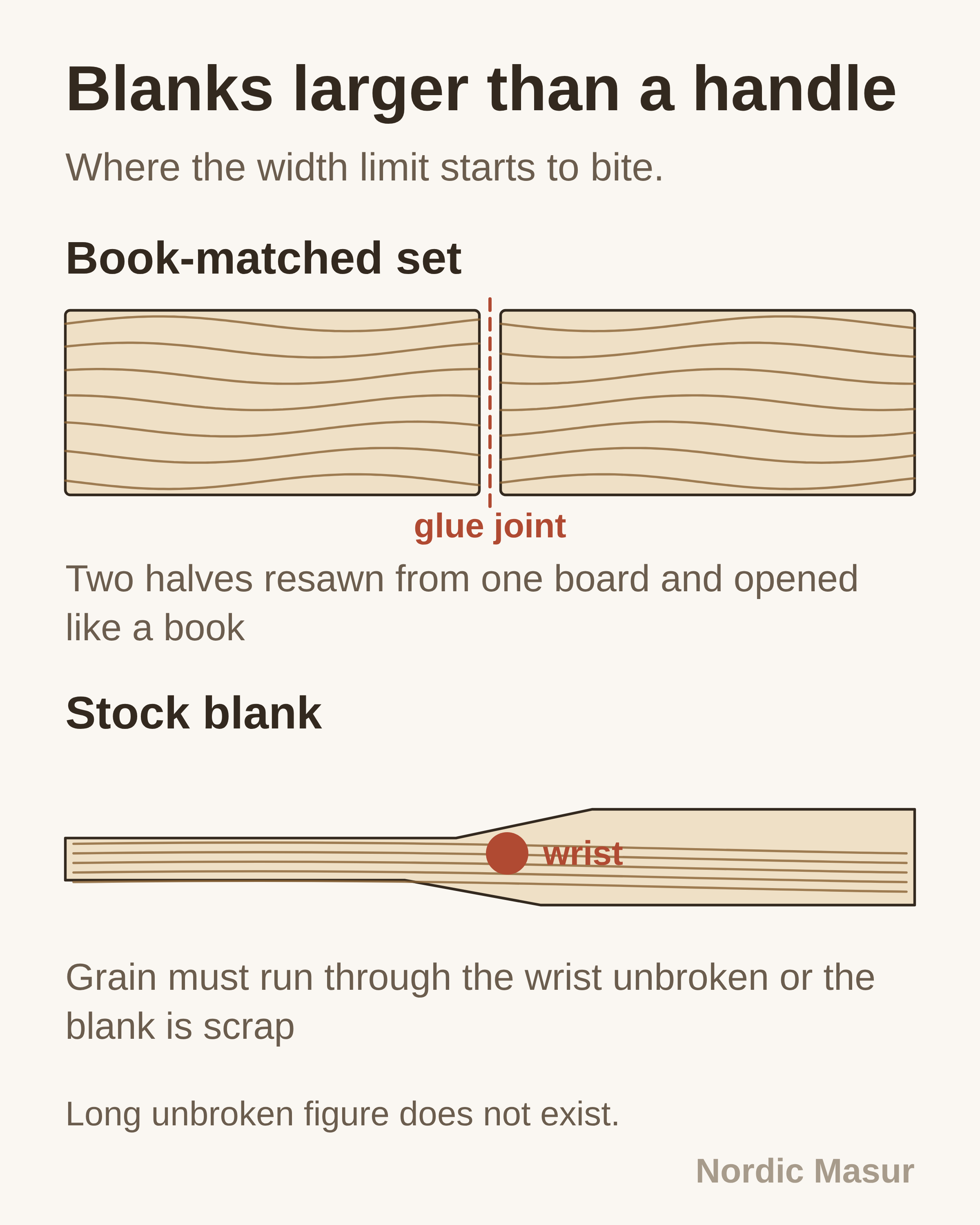
What a neck blank needs is quartersawn orientation and straight, continuous fibre along its length. Figured wood fails the second requirement by definition. Flame maple necks exist, are beautiful, and move more than plain quartersawn maple; the same logic applies harder to any wood whose figure comes from the fibres interweaving.
What a curly birch log can give and what it cannot
Logs here run 13 to 25 cm in diameter and 0.5 to 1.5 m long, and slabs and boards come out at 10 to 25 cm wide, 15 to 50 mm thick and 0.5 to 1.5 m long, cut to the thickness asked for. Those are what we sell; the blanks are cut from them by the maker. Set the board width against the body blank footprint and the answer is immediate: no body blank, ever, in one piece. A 355 mm width is not available, and boards wider than about 60 cm do not exist in this material at all.
What is available is a book-matched cap. Two pieces of 175 to 180 mm width and 510 mm length, resawn from one board and opened like a book, cover a body outline with margin, and the 15 to 50 mm thickness range means the board can be resawn into two caps rather than one. Neck blanks are dimensionally possible at 28 mm and 760 mm, and structurally a worse idea than quartersawn maple. Headplates, truss rod covers, control covers and pickup rings are all easy and all use the parts of a board a knife maker would have rejected.
The layout diagram with this post shows how the larger blanks come off a log of this diameter and where the book-match axis falls relative to the pith. The short version is that the widest useful face comes from the section nearest the outside of the log, and every centimetre of width you ask for reduces the number of logs that can supply the order.
To be clear about what arrives: the board. We saw to the thickness you ask for with the allowance you want, and the resaw and the book-match happen in your own shop. That is the right division of labour for a drop top, because where to open a board is a judgement about that particular face, made by whoever has to live with it, and not one to delegate to a sawyer working from an email.
Moisture, which decides your schedule
Boards leave here at 13 to 15% moisture content. Instrument work generally wants 6 to 8%. Nothing cut from them is safe to glue or machine until that gap has closed, and closing it takes weeks on a thin resawn cap and considerably longer on anything at 28 mm or above.
The practical sequence is to take delivery, sticker the pieces with air on both faces in the space where the instrument will be built, and measure with a meter weekly until the reading stops falling. Only then joint and glue. A cap glued at 12% onto a body at 7% will show a line at the joint within a year, and that line is not a finishing problem.
Plan for this at the ordering stage rather than the build stage. Most luthiers working with figured stock buy a season ahead for this reason, which is more useful than asking for wood to arrive at instrument moisture, something almost no producer can guarantee across a shipment. How the material is dried is described under curly birch.
What to specify
Give the finished cap dimension and the thickness you want the board at, working backwards from the resaw: two 6 mm caps plus the kerf and two clean-up passes means asking for something nearer 20 mm than 12. Say what your shop's equilibrium moisture content is, because it tells us how long you will be conditioning and whether a thinner cut would serve you better. Say how many instruments, since matching across a batch is what limits which logs can be opened.
Standard sizes as cut are listed under products. Anything outside them is worth asking about at the quote stage rather than buying a larger piece and cutting it down, which wastes the part of the log that was hardest to find.
Working on something in curly birch?
One line is enough to start. If you already know the sizes and quantity, add them below and we can quote with photos of the actual boards.
Prefer email? Write to hello@nordicmasur.com.