Curl, Flame, Quilt, Birdseye, Burl: A Glossary
Tiger maple, flame maple, fiddleback and curly maple are four names for the same thing: wood in which the fibre runs in waves rather than straight, so light alternates along the surface. Most of the confusion in figured-wood vocabulary comes from that kind of duplication, and the rest comes from terms that describe a cause, a pattern and a defect as though they were the same category.
What follows separates them by mechanism, which is the only way the vocabulary becomes usable. The section diagram on this post shows the main types cut through, and it is the fastest reference if you want the shapes rather than the words.
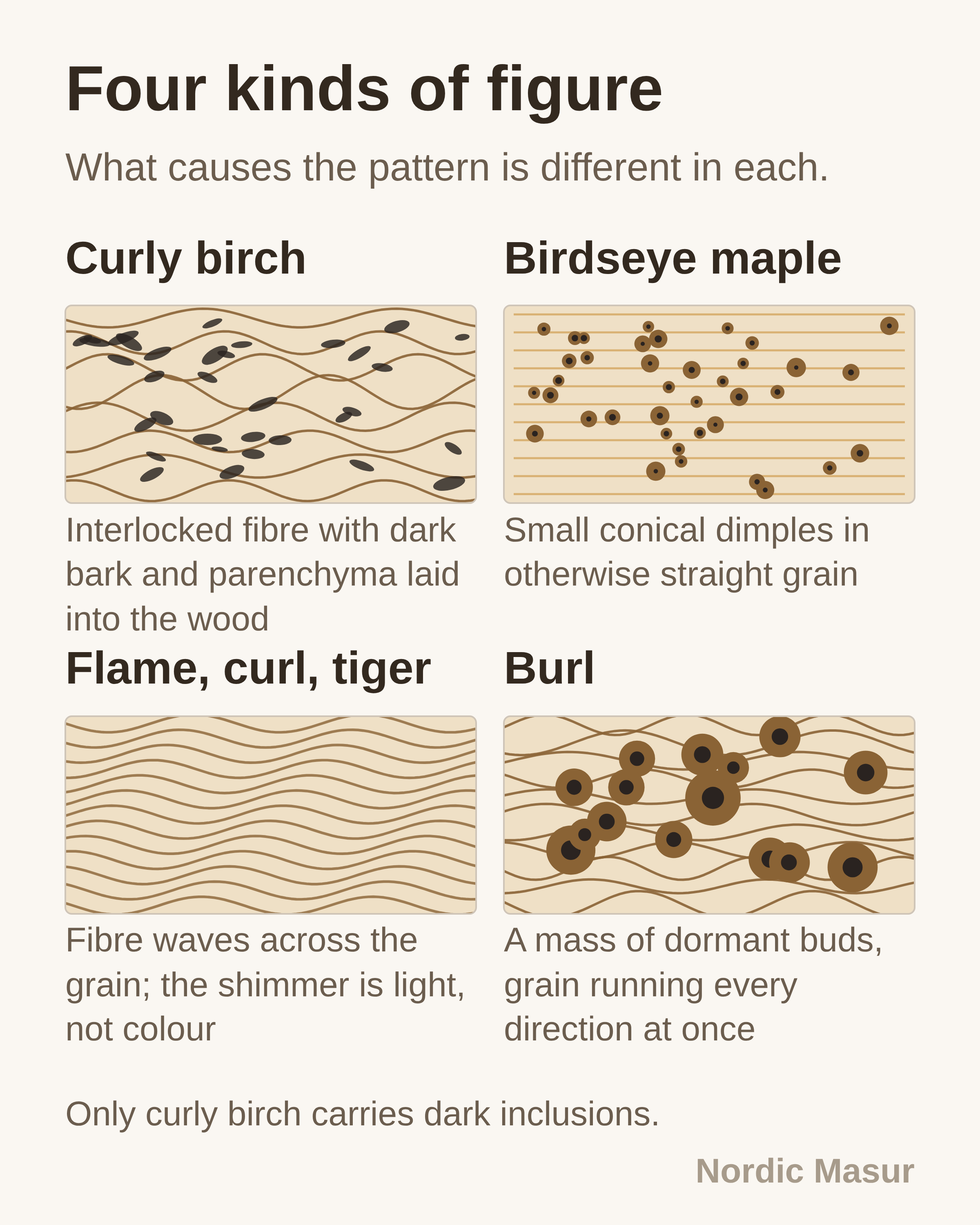
Figure caused by wavy fibre
Curl, flame, tiger, fiddleback and ripple all describe fibre that undulates across the width of the board, in a fairly regular cycle, so the surface shows bands of alternating light and dark that invert as the viewing angle changes. The optical effect is chatoyance. Fiddleback is the tightest and most even version, named for violin backs and ribs. Flame and tiger tend to be used for bolder, more irregular versions, and curl is the general term. They are the same phenomenon at different scales and regularities.
Blister is an exaggerated, rounded version, producing what looks like raised bubbles under the surface. Pommele is the same idea in a dense pattern of small overlapping circles, most often seen in African species such as sapele and makore.
Quilt is a larger, softer version again, producing broad billowing shapes rather than tight bands. It is most associated with big-leaf maple, Acer macrophyllum, on the western side of North America, and it shows best on a flat-sawn face rather than quartered.
All of these are figure in the fibre path, and all of them are largely invisible in bare sanded wood and dramatic under finish, because the effect depends on how light enters the surface.
Figure caused by local grain distortion
Birdseye is small conical dives in otherwise straight grain, almost entirely in hard maple, showing as small circles on a flat-sawn face. Its cause is still argued over. It cannot be identified from outside the tree and it cannot be reliably grown.
Burl is a growth on the trunk or root where the fibre has grown in whorls around clusters of dormant buds, with no consistent grain direction anywhere in it. Because there is no continuous fibre line, burl resists splitting, which is why it is the traditional material for one-piece carved vessels. It is unpredictable inside, often hollow or partly rotten, and it is sold by the piece rather than by dimension.
Crotch and feather figure comes from the fork where a stem divides. The fibre from two limbs meets and compresses, producing a plume or feather pattern. It is inherently short, it is prone to internal stress and checking, and it is nearly always used as veneer for that reason.
Ray fleck is not distortion at all but an exposed anatomical feature: the medullary rays, cut through by quartersawing. It is the flake in quartersawn oak, the silver grain in beech, and the lacewood pattern in Platanus. It appears only when the board is cut close to the radius.
Figure caused by something laid into the wood
This is the category curly birch belongs to, and it is the one most often collapsed into the others.
Curly birch, also called masur birch, Karelian birch, masurbjörk, valbjørk and visakoivu, is Betula pendula var. carelica, a hereditary variety of silver birch. The cambium divides unevenly, the fibre twists and interlocks, and dark bands of bark and parenchyma are laid in between the twists. The pattern you see is mostly those dark inclusions rather than a light effect, which means it is visible in bare wood, it reads the same from any angle, and it photographs close to how it looks. One or two silver birches in a hundred carry it. The mechanism is set out in full on the curly birch page.
The distinction matters when buying. Wavy-fibre figure needs finish and good light to perform. Inclusion figure does not. Two boards that look equally striking under shop lights can look very different on a workbench for this reason.
Patterns that are not figure
Spalting is fungal decay caught partway. The black zone lines are barriers where competing fungi met, and the bleached areas around them are wood that has begun to be digested. It is decorative and it is genuinely weaker than sound wood, softer in patches, and not appropriate for anything that holds food or takes load.
Ambrosia markings are staining around beetle galleries, most often in maple. The holes are real holes and the grey-green streaks are fungus the beetle carried in.
Sapwood and heartwood contrast, as in walnut or yew, is a colour difference between two zones of the tree rather than any distortion of the grain.
Mineral streak is discoloration from minerals taken up through the roots. It does not affect strength meaningfully but it will not match between boards.
None of the four are figure in the structural sense, and none of them can be graded with the same criteria. A supplier who lists spalted stock alongside figured stock is not being dishonest, but the two are bought for different reasons and behave differently under a tool.
Terms for how figured wood is sold
Bookmatched means two adjacent slices from the same piece, opened like a book, so the figure mirrors across the joint. It requires a piece thick enough to slice and long enough to matter, which is why bookmatched figured panels exist in maple and walnut and effectively do not exist in curly birch.
Slip-matched means consecutive slices laid in the same orientation rather than mirrored, so the figure repeats rather than reflects.
Matched pair, in knife and small work, means two pieces resawn from one block so the two faces mirror each other. Knife scales are conventionally cut at around 130 × 45 × 25 mm, and a maker resaws that block out of a board. It is achievable in a small species because it needs a block rather than a panel.
Grade describes how dense and even the figure is on the sawn face, and it is applied by hand after the log is opened because nothing about the standing tree predicts it. Our Premium is roughly 10 to 15 percent of what is cut, Standard 40 to 50 percent, and Economy the rest. All three are dried in the same cycle to the same moisture and are equally strong. The criteria are under grades.
Using the vocabulary when you buy
Ask which mechanism produces the figure in the piece you are being offered, not what it is called. A seller who can say whether the pattern is wavy fibre, local distortion or inclusions can also tell you how it will behave under a plane, whether it needs finish to show, and whether it will look the same in the photograph as in your hand.
Then ask what the largest uninterrupted figured face is. That single measurement rules out more materials for more projects than any other question, and in curly birch it is what the sizes under products are really telling you.
Working on something in curly birch?
One line is enough to start. If you already know the sizes and quantity, add them below and we can quote with photos of the actual boards.
Prefer email? Write to hello@nordicmasur.com.