Curly Birch vs Curly Maple
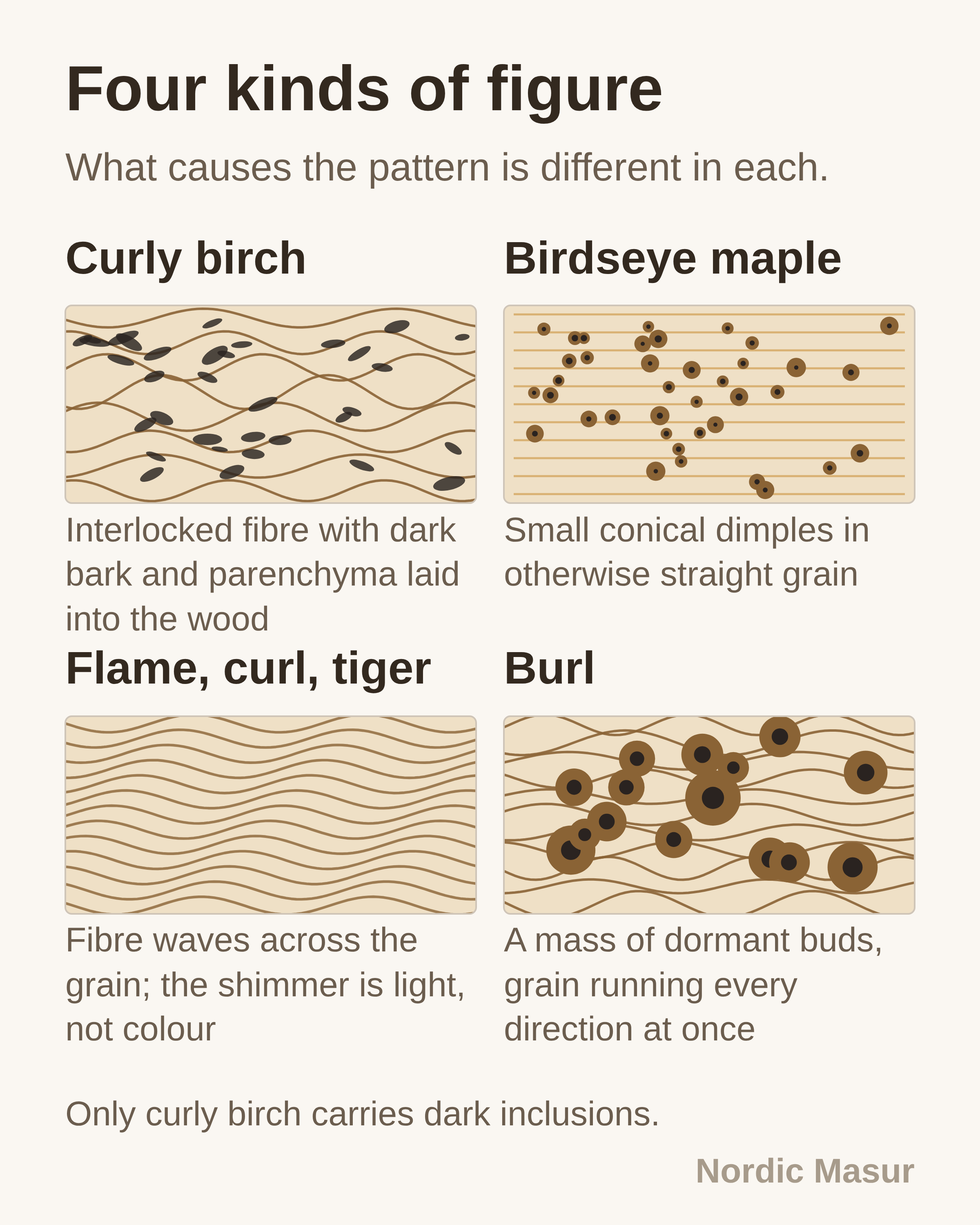
Curly maple and curly birch share a word and not a mechanism. Curly maple's figure is wavy fibre in an otherwise clean wood, and it shows as bands of light that move as you move, because the fibre alternately faces towards and away from you. Curly birch's figure is interlocked fibre with dark bands of bark and parenchyma laid in between it, and the pattern is largely there whether the light moves or not.
That is the distinction worth carrying into a purchase, because it decides whether the piece will look the same in a photograph as in the hand, and it explains why the two woods behave differently under an edge and under oil.
Chatoyance, and which wood has it
Curly maple's effect is called chatoyance: the alternating light and dark bands invert as the viewing angle changes, so the surface appears to ripple when the piece is turned. It is the whole point of the wood, and it is why fiddleback maple has been used on violin backs and ribs for four hundred years. A flat photograph shows some of it. The hand shows all of it.
Curly birch has some chatoyance where the interlocked fibre catches the light, but most of what you see is pigment: the dark inclusions are darker wood, and they stay dark from every angle. The practical consequence is that curly birch photographs closer to how it looks, which matters when you are selling finished work online, and that it does not reward being turned in the light the way maple does.
If the design depends on the surface moving as the viewer moves, maple is the material. If it depends on a defined pattern that reads from a metre away, birch is.
The section diagram on this post puts curl, flame, birdseye and burl side by side, and the useful thing it shows is that curly maple's figure exists in the fibre path while curly birch's exists in what has been laid between the fibres.
Species, hardness and what that costs you
Curly maple comes from both hard maple, Acer saccharum, at about 1,450 lbf Janka, and from the soft maples, Acer rubrum and Acer saccharinum, at roughly 950 to 1,000. A great deal of the curly maple on the market is soft maple, and it is not a lesser material for most uses, simply a softer one. Guitar necks tend to be hard maple; guitar tops are frequently soft.
Curly birch runs around 1,250 lbf, against about 1,100 for plain silver birch, with a specific gravity of 0.65 to 0.68 against about 0.60. It sits between the two maples, harder than soft maple and softer than hard.
For a knife handle, 1,250 is a useful number: hard enough that a thumb ramp holds a crisp edge and the butt survives being dropped, soft enough that it is shaped with hand tools without a fight. For a guitar neck, curly birch is stiff and dense enough to be plausible but is unavailable in the lengths that matter, which is a size problem rather than a property problem.
Size, which decides most cases
Maple is a commercial timber grown to substantial diameters over a large part of North America and Europe. Curly maple exists as wide boards, as bookmatched sets, as neck blanks over a metre long, and as veneer. If you need two matching 500 mm wide panels, they exist.
Curly birch grows slowly, stays small and is rare within its own species, with one or two silver birches in a hundred carrying the figure. It comes as logs of 13 to 25 cm diameter and 0.5 to 1.5 m length, green or air-dried, and as slabs and boards 10 to 25 cm wide, 15 to 50 mm thick and 0.5 to 1.5 m long, cut to the thickness asked for. Anything smaller than that, a blank of any kind, the buyer cuts. Boards wider than about 60 cm effectively do not exist, and long stock with unbroken figure does not exist in practice, because the figure fades in and out along the stem.
The comparison therefore resolves differently at different scales. At guitar-body and table-top scale, there is no contest, because one of the two materials is not available in the size. At knife-handle, pen, bowl and small-box scale the two are genuinely comparable and the choice is aesthetic. What we cut is listed under products.
How each one cuts
Curly maple's wavy fibre means the grain direction reverses on a regular cycle along the board, so a plane that cuts cleanly for 30 mm lifts fibre for the next 30 mm. The reversal is periodic and predictable, which is the saving grace: a high-angle plane, a toothed blade followed by a scraper, or a card scraper alone will get it flat, and once flat it sands well because the wood is otherwise clean and even in density.
Curly birch's interlock is not periodic. The direction changes several times within a few centimetres and not on a regular cycle, and there are also the inclusions themselves, which are softer and darker than the wood around them and can pluck out. It cannot be planed in a safe direction because there is no safe direction. Scrapers, low cutting angles, freshly sharpened edges and light passes are the approach, on the bench and on the lathe.
The inclusions are worth a specific note. They are bark and parenchyma, not defects, and they are structurally sound as part of the mass, but a large loose inclusion at a thin edge can chip out. In grading, how tightly the inclusions are held is part of what separates the grades, alongside how dense and even the figure is. All three grades are dried in the same cycle to the same moisture and are equally strong; the description is under grades.
Finish
Curly maple needs finish to perform. A bare sanded curly maple board shows a fraction of its figure, and it opens up dramatically with oil, and further with a film finish that increases surface reflection. Dye-and-sand-back treatments are standard practice on it, because the end grain in the wave zones takes dye more strongly and the contrast is amplified.
Curly birch shows most of its pattern dry, and oil deepens the background rather than revealing something that was not there. Dye works against it: the pale wood darkens faster than the already dark inclusions and the contrast flattens. Oil or hard wax oil, applied thin and wiped back, is the normal treatment, and the wood is dense enough that finish stays near the surface rather than sinking in, so fewer coats are needed than in plain birch.
Which to buy
Choose curly maple for anything large, anything pale, anything that is going to be dyed or heavily film-finished, anything where the surface should move as the viewer moves, and anything that has to match across multiple components.
Choose curly birch for small work where the figure is dense relative to the object, where a warm brown with genuine dark contrast is wanted, where hand tools will be doing the shaping, and where the piece is likely to be seen in photographs rather than in the hand.
For anyone working through a specific decision, the question that settles it fastest is the largest single figured face on the finished piece. Under about 200 mm in any direction, both are options and it is a matter of colour. Over that, the availability decides, and the details of how our wood behaves under an edge are on the curly birch page.
Working on something in curly birch?
One line is enough to start. If you already know the sizes and quantity, add them below and we can quote with photos of the actual boards.
Prefer email? Write to hello@nordicmasur.com.