Curly Birch vs Birdseye Maple
Birdseye maple and curly birch look like relatives in a photograph and are not. The eyes in birdseye maple are small conical distortions in otherwise straight grain, while the pattern in curly birch comes from interlocked fibre with dark bands of bark and parenchyma laid in between. One is a surface event, the other goes through the wood.
That difference decides nearly everything practical: what sizes are available, how each cuts, how each takes a finish, and which one belongs on a given piece.
What causes each figure
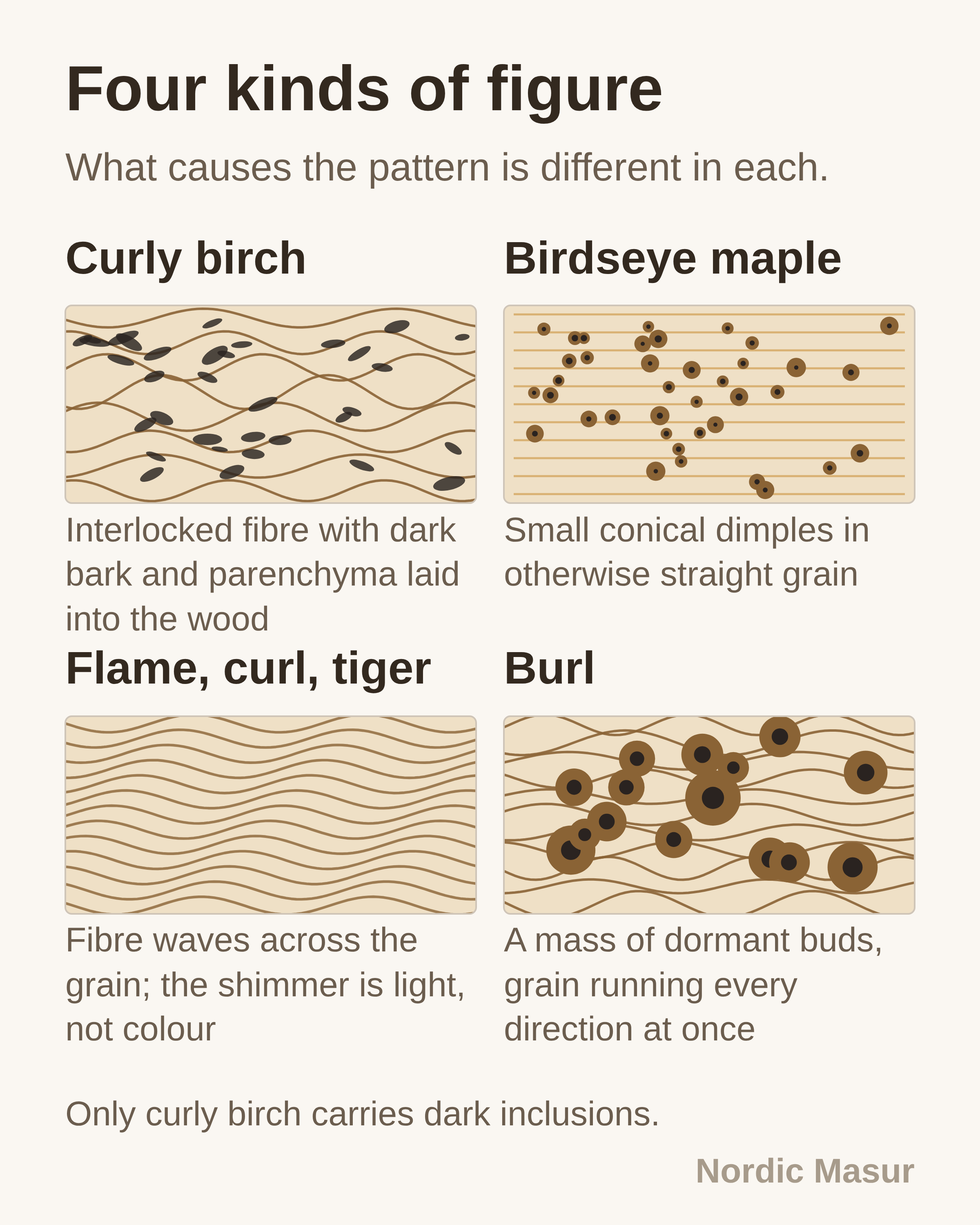
Birdseye occurs almost entirely in hard maple, Acer saccharum. The eyes are small indentations in the growth rings where the fibre has dived and returned, producing a cone that shows as a circle when the board is flat-sawn through it. The cause is still argued over, with proposals ranging from dormant bud traces to a genetic response to growth conditions, and no explanation has settled the matter. What is agreed is that it cannot be reliably induced, and that a tree carrying it cannot be identified from outside with any confidence.
Curly birch is Betula pendula var. carelica, a hereditary variety of silver birch in which the cambium divides unevenly. The fibre twists and interlocks, and dark bands of bark and parenchyma are laid between the twists. One or two silver birches in a hundred carry it, and the trait is heritable but unreliable: seed from a figured tree gives figure in only part of the offspring. Unlike birdseye, the trees can be recognised in the stand by a knobbly, dimpled trunk, though the density of the figure cannot be judged until the log is opened. The mechanism is set out on the curly birch page.
The comparison diagram on this post shows both in section alongside flame and burl, which is the quickest way to see that birdseye is a distortion of a straight-grained wood while curly birch has no straight grain to distort.
Hardness, density and colour
Hard maple runs around 1,450 lbf on the Janka scale. Curly birch is around 1,250, against about 1,100 for plain silver birch. Specific gravity for curly birch is 0.65 to 0.68, against about 0.60 for straight birch, with hard maple higher again.
Two hundred points of Janka is a real difference at the bench. Hard maple is noticeably harder work with hand tools, it dulls edges faster, and it burns at the drill and the router if feed rates are wrong. Curly birch sits in a range where hand tools still work comfortably, which is one of the reasons it became a knife-handle and carving wood in the north and hard maple did not.
For anything where dent resistance is the requirement, maple wins. For anything shaped by hand, the birch is less of a fight.
Colour separates them as clearly as hardness does. Birdseye maple is pale, close to cream or white when freshly cut, with the eyes reading as small darker dots. It yellows over years with light exposure and the contrast softens. It takes stain and dye readily, and much of the birdseye on the market has been dyed, which is worth knowing when comparing photographs.
Curly birch is a warmer honey to light brown, and the dark inclusions are genuinely dark, closer to brown-black. The contrast is inherent rather than a difference in light reflection, which means it photographs well but also means it does not change much with viewing angle. It darkens and warms with age and with oil.
If a design calls for a very pale figured surface, birdseye maple is the material and curly birch will not substitute. If it calls for contrast that survives being photographed badly, the reverse is true.
Availability and size, which is the big one
Hard maple is a commercial timber species grown across a large part of North America, reaching substantial diameters, and birdseye is selected out of that supply. Wide boards, long lengths, veneer and matched sets all exist. A birdseye maple guitar top or a table apron in matched flitch is a normal thing to buy.
Curly birch is none of that. The trees grow slowly and stay small, and it is sold as logs and sawn stock rather than as finished blanks. Logs run 13 to 25 cm in diameter and 0.5 to 1.5 m long, green or air-dried; boards come 10 to 25 cm wide, 15 to 50 mm thick and 0.5 to 1.5 m long. Boards wider than about 60 cm effectively do not exist, and long stock with unbroken figure does not exist in practice, because the figure comes and goes along the stem rather than running continuously.
That is the decisive practical difference. Anything requiring a large continuous figured surface points at maple. Anything small, where rarity and contrast are the point, points at birch. The sizes we cut are under products.
Working behaviour
Birdseye tears at the eyes. Each eye is a zone where the fibre dives out of the surface, so a plane or a scraper lifts a small chip from each one and a board can end up pitted. The remedies are a very high cutting angle, a freshly sharpened edge and light passes, or a scraper with a fine burr, or sanding from the start and accepting the loss of crispness.
Curly birch tears everywhere and nowhere in particular. The fibre direction changes several times within a few centimetres, so there is no safe direction to work in, and there is also no concentrated defect to plan around. Sharp edges, low cutting angles, light passes and a negative rake scraper handle it. On the lathe, higher speeds and shear cuts.
Both respond badly to sanding as a first resort: it removes the sound wood around a torn area faster than the torn fibres themselves, and leaves a dip that appears the moment finish goes on.
Maple's greater hardness is harder on tooling but more forgiving of a heavy hand, because the fibre is straight and predictable. Birch's interlock is easier on tooling and less predictable.
Finish
Birdseye maple's figure is largely a matter of light: the eyes reflect differently from the surrounding wood, and a finish that increases surface reflection increases the effect. Dyes and stains are used aggressively on it, and a dyed-and-sanded-back treatment that lodges pigment in the eyes is standard practice in guitar work.
Curly birch's figure is pigment rather than reflection, so it does not depend on finish to show. Oil deepens it and a film finish adds gloss, and a stain will muddy it because the pale background darkens faster than the already dark inclusions. Oil or hard wax oil, applied thin, is what this wood is usually given.
Choosing between them
Large surface, pale colour, needs to match across a set, and will be sanded and film-finished: birdseye maple. Small surface, warm colour, contrast that reads in any light, hand tools involved, and rarity is part of the point: curly birch.
At furniture scale the sizes decide it. There is real overlap in knife handles, pens, small boxes and instrument details, and there the choice comes down to colour and to how hard you want the wood under the tools.
What our three grades mean, and what share of the sawn output falls into each, is under grades. If you are comparing a specific birdseye board against curly birch for a specific job, the useful question is what the largest single uninterrupted figured face on the piece has to be, because that is where the two materials part company.
Working on something in curly birch?
One line is enough to start. If you already know the sizes and quantity, add them below and we can quote with photos of the actual boards.
Prefer email? Write to hello@nordicmasur.com.