Bowl Blanks: Green, Air-Dried or Kiln-Dried
Buy green if you intend to rough-turn and wait, air-dried if you want to finish a piece in one session and can live with a little movement, and kiln-dried if the piece has to fit something else. The three states are not grades of the same thing and a supplier who sells only one of them is not necessarily selling you the wrong one.
One practical note before the detail. We sell curly birch as logs, slabs and boards rather than as ready-cut blanks, and you cut your bowl blanks out of them. Logs come green or air-dried, whichever you ask for; slabs and boards are dispatched at 13 to 15 percent. So the moisture decision below is made when you order the material, not when you pick a blank off a shelf.
Green: cheap in effort, expensive in time
Green wood is above fibre saturation, somewhere north of 30 percent, and it behaves completely differently under a gouge. Long ribbons come off, edges stay sharp far longer, and the cut surface is clean in species that tear badly when dry.
The cost is that the wood is going to move, and it is going to move most across the grain. A bowl turned to finished thickness from green stock will go oval, sometimes by several millimetres across a 200 mm rim, and the base may lift. For a once-turned bowl that is the intended result and it can be a good one. For anything that has to sit flat or take a lid it is a failure.
The usual approach is to rough-turn to an even wall of about one tenth of the diameter, so a 200 mm bowl gets a 20 mm wall, then set it aside to dry and return to it. The even wall is the whole point: it lets the piece shrink without any part of it restraining another.
Green blanks also do not keep. Once they are cut to size the end grain is exposed on two large faces, and an unprotected green blank on a shelf will check within days in a heated room. They need to be sealed, bagged or turned quickly.
Air-dried: the default for most work
Air drying takes wood down towards ambient outdoor humidity over months. The traditional rule of a year per inch of thickness is conservative for small pieces and about right for slabs, and it produces the least internal stress because nothing is forced.
Air-dried stock cuts harder than green, wants sharper tools and produces dust rather than ribbons, but it is stable enough that a bowl turned to finish today will still be round next month. It is the right default for bowls, cups, and anything where a millimetre of movement does not matter.
The limitation is that air drying stops at outdoor equilibrium, which in a Nordic or British climate is somewhere in the mid-teens, and that is above what a heated workshop will eventually pull the wood down to. Air-dried stock brought indoors keeps shrinking, slowly, for weeks.
Kiln-dried: predictable, and worth paying attention to
A kiln cycle brings the moisture down under control to a stated figure and, done properly, relieves some of the drying stress air drying leaves behind. Done badly it case-hardens the outside and the piece springs or cracks the moment the lathe opens it up.
Kiln-dried is what you want for boxes with fitted lids, segmented work, laminated blanks, anything glued, and anything where two parts have to stay the same size relative to each other. It is unnecessary for a plain bowl and it is the wrong choice if you like the way green wood cuts.
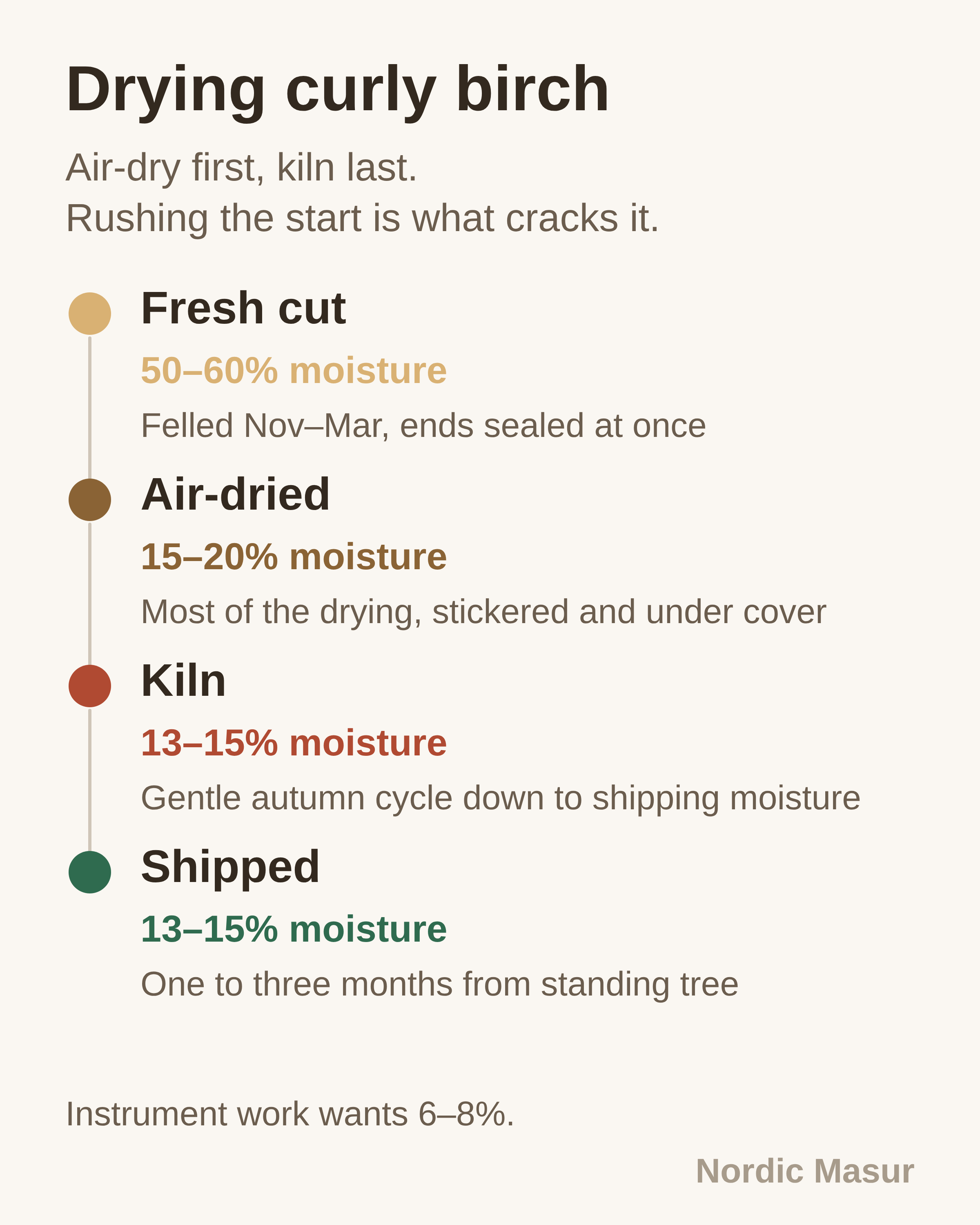
Our sawn stock sits between the second and third of these. Curly birch slabs and boards are mainly air-dried outdoors and then finished with a kiln cycle in autumn, and they leave at 13 to 15 percent moisture content. Logs are the exception: they go out green or air-dried as the buyer chooses, which is what carvers and kuksa makers want. From standing tree to a board we will ship is one to three months depending on the drying method, with felling concentrated between November and March when the ground is frozen. The chart above shows how the moisture falls across that period and where the kiln cycle sits in it.
Thirteen to fifteen percent is a transport and storage figure. It is not what your workshop will settle the wood at, and it is well above the 6 to 8 percent that instrument work asks for. Treat it as a known starting point rather than a finished condition.
Why figured blanks are harder to dry than plain ones
Straight-grained wood shrinks predictably: about twice as much tangentially as radially, and very little along the length. A blank with interlocked, wandering fibre has no single tangential direction. Within one blank, adjacent zones want to shrink along different axes, and they pull against each other.
That is why figured stock checks more readily, why it is dried more slowly, and why a proportion of every batch is lost. It is also why figured boards often arrive slightly out of true. A board that has moved a millimetre during drying is behaving normally; one that arrives dead flat and then moves on your shelf has been dried fast and has stress in it.
Curly birch has one advantage here. The interlocked fibre that makes it awkward to dry also means a check that starts usually stops after a few millimetres rather than running the length of the board. Losses tend to be at the ends, which is why boards are trimmed back from the log ends rather than cut out to them.
Storing blanks so they stay usable
- Seal the end grain of anything green or freshly cut, with wax emulsion or two coats of ordinary PVA, and seal it the day it is cut rather than the week after.
- Stack with stickers between layers so air reaches every face. A stack of blanks sitting flat on each other dries only at the edges and stains where they touch.
- Keep them off a concrete floor and away from any heat source. A radiator or a wood stove across the room is enough to check the nearest end of a stack.
- Bring blanks into the room where they will be turned at least two weeks before you use them, and longer for anything over 100 mm thick.
- Weigh a sample blank every week if you are drying your own. When the weight stops falling, the drying has finished, and that is more reliable than a pin meter on figured stock where the fibre direction varies.
Deciding what to order
Ask yourself whether the piece has to fit something else. If it does, order sawn stock at 13 to 15 percent and condition it yourself. If it does not, a log is the cheaper route to a bowl blank, and asking for it green is worth doing if you enjoy the process and have somewhere to store roughed-out bowls for a few months.
What we saw and the sizes it comes in are listed under products, and delivery timing, which matters more than people expect for wood that arrives at a different humidity from the one it left, is covered under shipping. If your work needs a moisture state other than the 13 to 15 percent sawn stock is dispatched at, or you want logs green rather than air-dried, say so in the enquiry rather than after the box arrives, through contact.
Working on something in curly birch?
One line is enough to start. If you already know the sizes and quantity, add them below and we can quote with photos of the actual boards.
Prefer email? Write to hello@nordicmasur.com.