Best Wood for Knife Handles, Ranked by What Matters
The best handle wood for a given knife is the one that stays the size it was glued at, in the conditions that knife will actually live in. Hardness comes fourth on the list of things that decide a handle, behind dimensional stability, resistance to splitting along the handle axis, and whether you can get two matched pieces of it.
Most rankings of handle woods are rankings of Janka numbers, which is why they put desert ironwood at the top and stop there. That ordering is useful for a chopper that lives in a truck bed and close to useless for a slip joint that will sit in a pocket at 20°C and 45% relative humidity for twenty years. What follows ranks the properties first, then says which woods meet each one.
1. Dimensional stability
A handle fails at the scale-to-tang joint long before the wood itself fails. Every scale is glued to a material that does not move at all, so every millimetre of seasonal movement in the wood shows up as a proud edge, a pin that stands above the surface, or a gap at the front bolster. Movement is tangential and radial, it is not the same in both directions, and it is driven by the wood reaching equilibrium with the air around it.
Two things reduce it. The first is oil content, which is why the tropical hardwoods with high extractive content sit near the top of every serious handle list. Cocobolo, African blackwood, desert ironwood and lignum vitae are all hard, and all of them are also chemically slow to take on moisture, which is the property doing most of the work. The second is resin stabilising, which fills the cell structure with cured acrylic and takes movement close to zero. That is a manufacturing process rather than a property of a species.
Everything else moves, including curly birch, and the way to manage it is to glue at a moisture content close to where the knife will live and to let the material acclimatise in the workshop before cutting. Our boards ship at 13 to 15%, which is right for outdoor and unheated use in northern Europe and too wet for a centrally heated shop in Arizona. Let them sit.
2. Resistance to splitting along the handle
A handle is a lever. Every time the knife is used hard, the scale is being asked not to split from the pin hole toward the butt. Straight-grained wood splits along that line readily. Interlocked and irregular grain does not, because there is no continuous fibre path for a crack to follow.
This is the property that put figured birch, birch burl and the burls generally into traditional handle work, and it is the one that most modern comparisons miss entirely. In curly birch the fibres twist and interweave and dark inclusions of bark and parenchyma are laid between them, so the failure path is broken every few millimetres. It is the same reason a burl cap resists a hammer blow that would split a straight billet of the same species. The structure is described in more detail under curly birch.
3. Whether you can get a matched pair
For a full-tang knife you need two scales that mirror each other. That is a supply question rather than a wood property, and it eliminates a large part of the market. Burl caps are one-offs, so a second piece matching the first is a matter of luck. Figured stem wood can be resawn from a single block so the two faces open like a book, and the conventional block is around 130 × 45 × 25 mm.
We sell boards rather than scale pairs, so that resaw is yours to make, and it is the better arrangement for matched work: you see the whole face before deciding where the block comes from. Boards run 10 to 25 cm wide, 15 to 50 mm thick and 0.5 to 1.5 m long, cut to the thickness you ask for, and a 25 mm board is already the right thickness for a conventional pair. If you are making a batch rather than one knife, say so at the quote stage, because matching across ten handles decides which logs can be opened at all. Sizes as cut are listed under products.
4. Hardness, within a range
Hardness matters between about 900 and 1,600 lbf on the Janka scale, and stops mattering much above that. Below that range the wood dents under thumb pressure and will not hold a crisp chamfer. Above it you gain dent resistance that a handle rarely needs and lose workability that you always need.
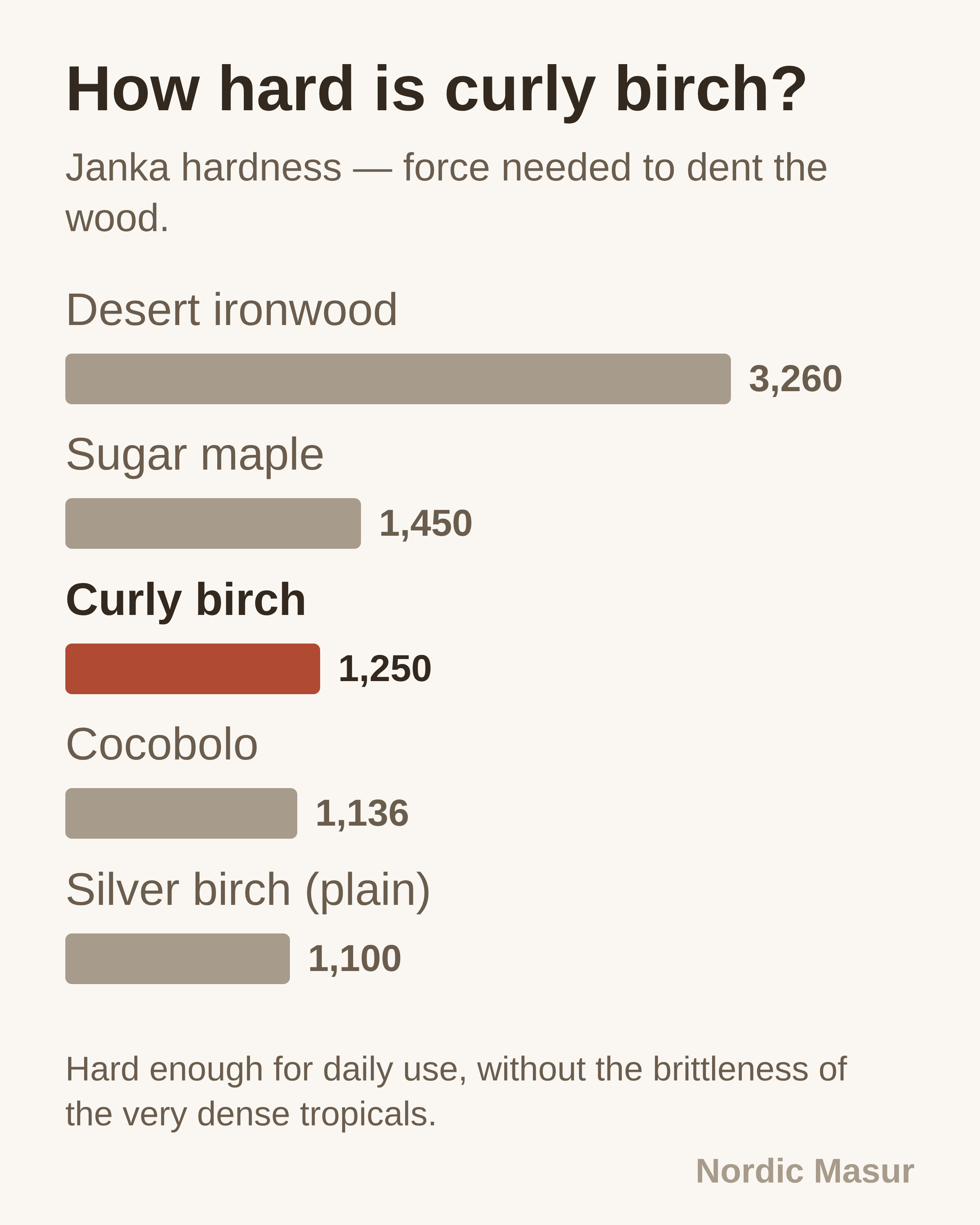
Plain silver birch sits at about 1,100 lbf. Curly birch runs around 1,250, being the same species laid down at 0.65 to 0.68 specific gravity rather than about 0.60. Sugar maple, the usual benchmark for a hard pale handle wood, is near 1,450. The dense tropicals sit well above all of these, and the practical effect is that you file and sand them rather than cut them. The hardness chart with this post sets out the comparison.
The point of the chart is not that harder is better. It is that a 1,250 lbf handle and a 3,000 lbf handle both survive normal use, while only one of them can be shaped with a rasp and a card scraper on a kitchen table.
5. What it does when it gets wet, and what it does to you
Unstabilised wood in a dishwasher or in salt water will move and eventually check, whatever the species. If the knife will be immersed regularly, stabilised material or a synthetic is the honest answer, and no natural handle wood is a better choice than G10 for a dive knife.
The sensitiser question is usually left out. Cocobolo and several of the rosewoods cause contact dermatitis and respiratory reactions in a meaningful proportion of makers, and the reaction gets worse with exposure rather than better. Most Dalbergia rosewoods are also CITES-listed, so shipping them across a border means paperwork, which for a small maker selling internationally can decide the material on its own. The pale northern hardwoods carry neither problem.
Where each species lands
Desert ironwood and African blackwood win on stability and hardness and lose on workability, cost drivers and availability in pairs. Cocobolo and the rosewoods are beautiful and stable, with a sensitiser risk and a paperwork burden attached. Stabilised maple and stabilised burl win outright on stability, at the price of a slightly plastic feel and a surface that is no longer really wood at the top half-millimetre.
Curly birch sits in a narrower place and it is worth being clear about it. It is harder than plain birch, easy to shape with hand tools, strongly resistant to splitting along the handle, and it needs no stabilising for normal carry and kitchen use. We do not stabilise and do not sell stabilised stock. It moves more than an oily tropical, and it is the wrong choice for a knife that will be soaked. All three of our grades are dried in the same cycle to the same moisture and are equally strong; what separates them is how dense and even the figure is.
What to decide before you order
Decide where the knife will live, because that sets the moisture content you should be gluing at. Decide whether any part of the handle will be under wrap, leather or birch bark, because figure hidden under a wrap is figure you paid for and will never see. Then work out the board thickness that gives you whole pairs without a wasteful resaw, and say the quantity and whether pieces must match. Those are the lines a figured-wood quote is actually built from.
Working on something in curly birch?
One line is enough to start. If you already know the sizes and quantity, add them below and we can quote with photos of the actual boards.
Prefer email? Write to hello@nordicmasur.com.