The Best Wood for a Kuksa, and Why Birch Wins
Birch is the right answer for a kuksa, and burl birch is the right answer within birch. Curly birch is the practical substitute when you want wood of a known size rather than whatever the burl happens to be, and after those two the field drops off quickly for reasons that have more to do with pores and taste than with hardness.
What follows is the reasoning rather than the ranking, because the ranking changes depending on whether you are carving green, carving dry, turning the bowl, or making one cup versus twenty.
What the wood actually has to survive
A kuksa is a thin-walled vessel that gets filled with near-boiling liquid, emptied, left to dry in cold air, and refilled. The wall is wet on one face and dry on the other for an hour at a time, several times a day, for years. That is a harder service condition than almost anything else a carver makes.
Four properties decide whether a species copes.
- Pore structure. Diffuse-porous woods with small, evenly spread pores hold liquid at the surface and release it. Ring-porous woods have rows of large open vessels that act as straws, wick liquid into the wall and hold it there.
- Taste and extractives. Tannins, resins and aromatic oils all transfer into hot liquid. Some fade after a few uses, some never do.
- Movement. The wall is thin and restrained by its own curvature, so a species that moves a lot tangentially will check across the rim.
- Fibre behaviour under a thin section. A wall of five or six millimetres has nothing holding it together but its own fibre. Straight grain splits along its length. Interlocked or random fibre does not.
Hardness barely enters into it. A kuksa is not load-bearing, and a cup in a soft species simply dents rather than failing.
Why burl comes first
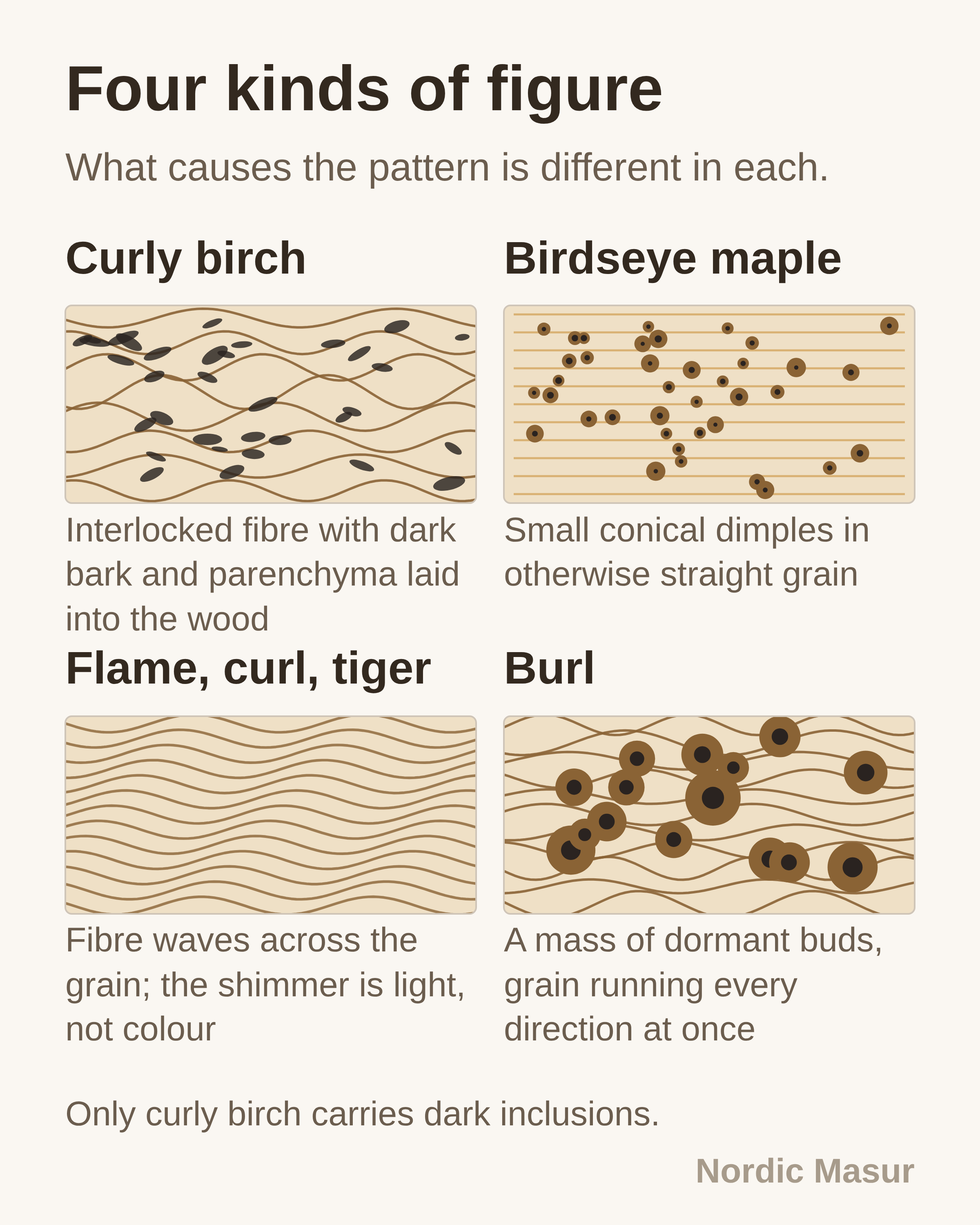
Birch burl has no consistent grain direction at all. The fibre has grown in loops and whorls around dormant buds, so there is no continuous line for a split to follow. That single property is why the burl cup is the traditional one across the whole north: a carver working without glue, hoops or joints needs a material that will not open up when it dries.
The costs of burl are size and unpredictability. A burl is whatever size it grew, it is often hollow or rotten in the middle, and you do not know which until it is cut. Anyone who has bought a few knows the yield is poor and the good ones are worth keeping.
Why curly birch is the practical second
Curly birch is Betula pendula var. carelica, silver birch with a hereditary irregularity in the cambium. The fibre twists and interlocks along the length of the trunk, and dark bands of bark and parenchyma are laid in between the twists. One or two trees in a hundred carry it. Because the figure runs through the stem rather than sitting in a lump, it can be sawn into logs and boards of stated dimensions.
For a cup, that gives you three things burl does not. The wood arrives at a size you chose. The fibre is interlocked enough to resist a running split without being as unpredictable as burl to hollow. And the wood is measurably denser than plain birch, at a specific gravity of 0.65 to 0.68 against about 0.60, with a Janka hardness around 1,250 lbf against about 1,100 for straight silver birch, so a rim takes knocks without bruising.
The trade-off is honest enough to state plainly. Curly birch still has a grain direction, weaker and wandering but present, so a wall carved down to three millimetres in a hurry can still open a crack at the rim. Burl will forgive that and curly birch will not entirely.
The diagram above sets curl, birdseye, flame and burl side by side in section, which is the fastest way to see why the two birch options behave differently under a hook knife even though they look related in a photograph. What the grades mean for how tight and even the figure is, and what share of our output falls into each, is set out under grades.
The species that also work
Alder is the traditional everyday alternative in Finland and Sweden: soft, neutral in taste, easy to hollow green, and it darkens pleasantly with use. It dents readily and will not survive a lifetime of hard camp use, but as a first cup it is hard to beat.
Lime, or basswood in North America, cuts beautifully and tastes of nothing, but it is porous enough that a cup made from it stays damp and is best kept for carving practice rather than for coffee.
Maple, cherry and pear are all fine-pored, food-neutral and stable, and all three make good cups. They are less traditional and more inclined to split along their straight grain in a thin wall, so walls need to be left a little heavier.
Apple and other fruitwoods behave much like cherry and are usually available only in small, checked pieces, which suits a cup.
The species to avoid, and why
Oak, ash, chestnut and elm are ring-porous. Liquid travels along the open vessels, the wall stays wet, and oak adds enough tannin to turn tea black and taste metallic. They look right and they do not work.
Spalted wood of any species is worth refusing for anything that holds a drink. Spalting is fungal decay caught partway, the black lines are zones where competing fungi met, and the softened areas around them are neither strong nor something to drink out of.
Resinous softwoods flavour everything. Olive and some tropical species carry oils that taste strongly at first and never quite stop. Any species with a reputation for skin irritation or respiratory sensitising is not a sensible choice for a vessel, regardless of how it looks.
Sizing the wood before you order
A cup of 200 to 250 ml with a sensible wall needs a block around 100 mm across and 80 to 100 mm deep for the bowl alone, plus 60 to 90 mm of handle. You cut that block yourself, because we sell logs and sawn stock rather than cup blanks. A log of 13 to 25 cm diameter and 0.5 to 1.5 m length, green or air-dried as you prefer, yields several such blocks along its length; a 40 or 50 mm board suits a shallow cup but not a deep one. We do not carry burl either, so that option has to come from elsewhere. The sizes we cut are under products.
Two decisions are worth making before you enquire rather than after. First, whether you will hollow green or work the wood at the 13 to 15 percent moisture content it is dispatched at, because that changes the tools and it changes how much oversize to leave when you cut the block. Second, whether the figure is meant to show on the outside of the bowl or on the handle, since the two are cut from different orientations in the same log, and which of them you care about determines how the log is opened. Say both in the enquiry and the answer comes back specific. More on how the wood behaves under an edge is on the curly birch page.
Working on something in curly birch?
One line is enough to start. If you already know the sizes and quantity, add them below and we can quote with photos of the actual boards.
Prefer email? Write to hello@nordicmasur.com.