
Wood Arrived from Finland: Let It Sit First
Leave the box closed for the first day. A parcel that has travelled in an unheated hold and a winter delivery van arrives at around the outside temperature, and unwrapping cold wood in a warm room puts condensation straight onto the surface. Give it twenty-four hours to reach room temperature with the packaging still on, then open it, and then get the plastic off completely.
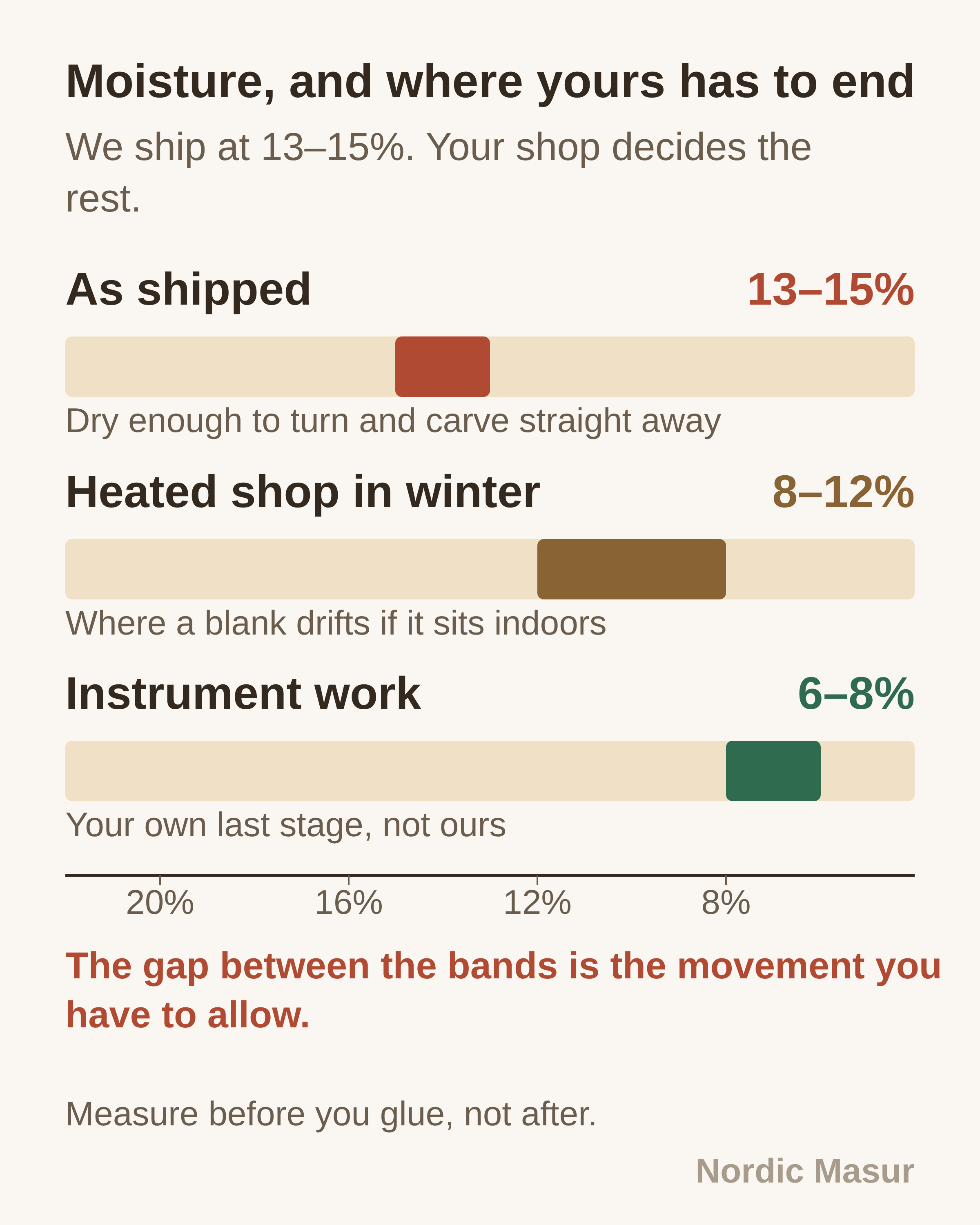
After that the wait is longer than most people expect, and how long depends entirely on where you are. Slabs and boards leave here at 13 to 15% moisture content, which is the right figure for the northern European workshops and outdoor use most of them go to, and logs leave green or air-dried as the buyer chooses. A heated workshop in Minnesota in January is a different planet, and the gap has to be closed slowly.
The first hour: check it and photograph it
Once the wrapping is off, look at the ends of every piece. End checks are the failure that travels, and they are easiest to catch on day one. A check that is a hairline on arrival and gets ignored will be 40 mm deep in a month, because the ends lose moisture several times faster than the faces and the stress concentrates there.
Photograph anything that looks wrong before you move the pieces, including the packaging as it arrived. Transit damage claims depend on evidence taken before the consignment was handled, and a week later nobody can tell what happened where. What our shipments involve and how they are packed is set out under shipping.
If you do see checking starting, seal the end grain now, with a wax emulsion end sealer if you have it and with two thick coats of PVA if you do not. It does not repair the check. It stops the next one.
Stacking it properly
Sticker the pieces. That means laying them flat with strips of dry scrap, 20 mm square is ideal, between every layer, so that air reaches both faces of everything. Put the stickers at 300 to 400 mm intervals and line them up vertically through the stack, because a sticker that is not directly above the one below puts a bending load into the boards and you will get exactly the curve you built in.
Weight on top of the stack helps and costs nothing. A few concrete blocks or a couple of bags of sand across the top layer restrains the cupping that thin stock does as it gives up moisture.
Where the stack goes matters as much as how it is built. Off the floor, particularly a concrete floor, which wicks. Away from an outside wall. Out of direct sunlight through a window, which will dry one face and not the other. Nowhere near a radiator, a wood stove or a dehumidifier outlet. Never in a sealed plastic box or a bag, which is the most common way a good board turns mouldy.
How long, by where you are
For Britain, Ireland and coastal north-west Europe, where a workshop runs somewhere around 10 to 12% equilibrium, the gap from 13 to 15% is small. Two to four weeks on 25 mm stock, six to ten weeks on 50 mm. This is the easy case.
For the northern United States and inland Canada in winter, indoor equilibrium runs 6 to 7% and the drop is large. Six to twelve weeks on 25 mm stock and considerably longer on a thick block cut for turning, and the risk of checking is real because the difference between the wood and the air is at its annual maximum. The same shipment arriving in July is a far gentler proposition.
For the interior west of the United States and the dry Australian inland, equilibrium can sit at 5 to 6%, which is the biggest drop of all. Do it in two stages: an unheated garage or outbuilding for the first month, then the workshop. Moving the wood halfway and letting it settle before the second half is the single most effective thing you can do to avoid checking, and it costs only patience.
For Sydney, Melbourne, Auckland and similar coastal temperate conditions, the target is close to the shipping figure and the wait is short.
Knowing when it is ready
The reading you want is not a number, it is a repeat. Take a measurement, wait a week, take it again. When two readings a week apart are the same, the wood has stopped moving and is at equilibrium with that room, and that is when you cut.
A moisture meter is the obvious tool, and a pinless one needs the density set correctly. Curly birch runs 0.65 to 0.68 specific gravity against about 0.60 for plain silver birch, so a meter left on a generic birch setting will read low.
The cheaper method needs no meter at all. Put one piece on a kitchen scale, write the weight and the date on it in pencil, and weigh it weekly. Wood loses weight as it loses moisture and nothing else changes, so when the weight stops falling, the piece is done. It is more reliable than most hand-held meters and it costs nothing.
What not to do while you wait
Do not cut to final dimension, do not glue anything, and do not apply a finish that will cure over a surface still going to shrink beneath it.
Do not rush thick stock by putting it somewhere warm. Moisture leaves the surface of a 60 mm piece far faster than it comes out of the middle, so heat makes the gradient steeper rather than the drying faster, and the gradient is what causes checking.
Do rough out oversize if you are impatient and the piece allows it. A bowl blank roughed to a 25 mm wall dries in a fraction of the time the solid block would, and this is why rough-turning and coming back months later has been standard practice for as long as people have turned green wood.
Why this material in particular
The figure in curly birch comes from the cambium dividing unevenly so the fibres twist around one another, with dark inclusions of bark and parenchyma between them. That structure is what makes the wood resist splitting under a lever, and it is also why a check in it does not run in a straight line you could cut out. It follows the inclusions and wanders, and by the time you have chased it you have lost the piece.
The wood is mainly air-dried outdoors here and finished with a kiln cycle in autumn, and from standing tree to a board we will ship runs one to three months depending on the drying method. That produces stable stock for this climate. Getting it to yours is the part that happens at your end, and it is not a failure of the drying; it is the same step every imported hardwood needs. More on the structure and the drying is under curly birch.
Plan the order around the wait
Order thinner stock than you think you need if the schedule is tight, because thickness drives conditioning time more than anything else and a 25 mm board is ready in a quarter of the time a 50 mm one is. We cut to the thickness you ask for, so this is a decision you actually get to make. Order in summer rather than mid-winter if the destination is a dry heated interior, because the receiving conditions are far kinder. And order early enough that the wood is sitting in your shop while you are still drawing, rather than arriving the week you wanted to cut. Sizes as we cut them are listed under products.
Working on something in curly birch?
One line is enough to start. If you already know the sizes and quantity, add them below and we can quote with photos of the actual boards.
Prefer email? Write to hello@nordicmasur.com.